
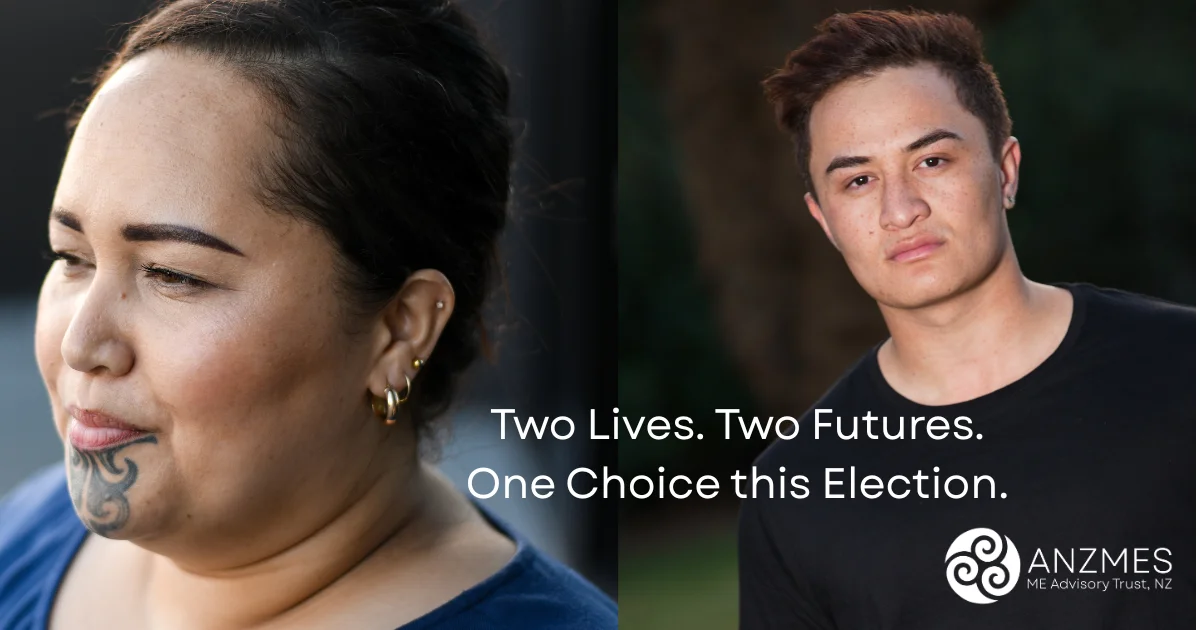
Two Lives. Two Futures. One Choice This Election.
Person A — Aroha and Dr Ngata
Aroha* became unwell after a viral illness. She struggled at first — fatigue, dizziness, crashes after activity — but she was lucky. She found *Dr Ngata, a clinician who recognised post‑exertional malaise, understood orthostatic intolerance, and knew that pacing prevents deterioration.
Together, they built a plan that protected her energy envelope.
Aroha still lives with ME, but she avoided the worst harm.
She stayed connected to her whānau, kept some independence, and accessed community support early.
Aroha represents what’s possible when the system works.
Person B — Wiremu and Dr Jones
Wiremu* also became unwell after a viral illness.
But his GP, *Dr Jones, didn’t recognise the signs.
Wiremu was told to push through, exercise more, try CBT, stay positive.
He followed the advice — because he trusted the system.
Every time he pushed, he crashed.
Every crash made him worse.
Within a year, Wiremu was in a darkened room, unable to stand, unable to tolerate sound or light.
His whānau were exhausted, unsupported, and invisible to the system.
Wiremu represents what happens when the system fails.
Why We’re Asking You to Act
*Dr Hana Ngata, Dr Jones, Aroha, and Wiremu are fictional, representative characters. However, they reflect the real experiences of doctors and patients across Aotearoa and are used to illustrate what early recognition and intervention for ME and Long COVID can — and should — look like in practice and the consequences and harm caused when this does not occur.
Aroha and Wiremu show the truth:
ME and Long COVID outcomes depend on the system — not the person.
This election, we need MPs to commit to a plan that ensures more people become Aroha, not Wiremu. We’re asking our members, whānau, and allies to help ensure the system protects people rather than abandons them. We’re asking you to connect with your local MP about what their party plans to do to ensure the needs of people living with complex long-term conditions are met. We’re asking the government to commit to act now, not one day in the future, because every second counts for people like Aroha and Wiremu.
When the system works
Some people become unwell after a viral illness and receive early recognition. Their clinician understands PEM, orthostatic intolerance, and pacing. They avoid deterioration, stay connected to whānau, and access community support early. They remain independent, safer, and visible to the system.
When the system fails
Others are told to “push through,” exercise more, or stay positive. Every crash makes them worse. Within months, they may be unable to stand, tolerate light or sound, feed or bathe themselves, or access care. Their whānau carry everything alone. They become invisible to the system.
This difference is preventable.
It is the difference between early recognition and preventable deterioration. Between community care and postcode lotteries. Between long‑term planning and falling through the cracks every election cycle.
1 in 30 people in Aotearoa New Zealand are living with a post‑viral long‑term condition.
That’s one child in every classroom.
One staff member in every medium‑sized business.
Every community, every whānau, every electorate is affected.
We all know someone facing long‑term illness.
185,000 people are living with Long COVID.
135,000 of them meet the diagnostic criteria for ME.
An additional 45,000 New Zealanders were already living with ME before the pandemic.
And every flu season, every COVID wave, every reinfection can generate more.
This is not a political issue.
It is a health issue, an economic issue, a social issue, and a moral issue.
It is about equity, and about meeting basic human rights for people whose lives have been profoundly altered by post‑viral illness.
The Reality is that long-term conditions are Breaking Families and the Economy
We see the same pattern over and over:
- A previously healthy working adult becomes disabled by ME, Long COVID, or another LTC.
- The household shifts from two incomes to one.
- The healthy partner becomes the sole earner, primary carer, household manager, and often the default parent.
- This load is unsustainable, and many partners eventually experience burnout or illness themselves.
- When the healthy partner becomes unwell, the family is left with no income at all and no support
This is not rare — it is widespread, predictable, and preventable.
The current system does not recognise this reality. It does not count the right things. It does not intervene early. And it does not support families in ways that reduce long‑term cost to taxpayers.
Why this matters now
The increasing prevalence of post‑viral conditions makes it clear that current gaps can no longer be sustained. Conditions with far lower prevalence already receive dedicated services, research funding, and government commitment. People with ME and Long COVID deserve equitable access to the same level of coordinated care.
Early recognition and intervention reduce diagnostic delays, prevent deterioration, enable people to maintain employment and independence, support people when they need it most, and lower hospitalisation rates. The cost of doing nothing is increased pressure on primary care, reduced labour force participation, lower household income and consumer spending, heightened carer burden shouldering clinical responsibilities they were never trained for, and avoidable hospitalisation — all of which carry significant economic consequences.
We believe there are three core pillars that when implemented, provide a fair, effective system.
We ask the government to partner with ANZMES to develop these three pillars for long-term conditions.
Pillar 1: Prevention & Early Recognition | Pillar 2: Long‑Term Investment in Community Care | Pillar 3: A 10‑Year Cross‑Party Plan for Long‑Term Conditions |
| This pillar focuses on reducing harm through earlier diagnosis, better health literacy, and consistent clinical standards. It includes: – Early diagnosis & screening – Health literacy & prevention – National LTC coding/tracking – Workforce training – Diagnostic standards co‑designed with NGOs – Harm-prevention as the first principle of care | This pillar addresses the need for sustainable, equitable services for people living with long‑term conditions. It includes: – Ending postcode lotteries – Sustainable funding for NGOs who meet need now – NGO integration into referral pathways – Crisis and respite services – Specialist workforce development – Residential care where needed, trained staff | Because health is an investment that must outlast political cycles, this pillar calls for long‑term planning and accountability. It includes: – A national LTC data registry – Research and innovation funding – Annual Reporting and Accountability – A CPPG committed to partnering with ANZMES to develop tangible change – A clear implementation strategy with cross‑party agreement |
| For ME and LC, this aligns with our long‑standing advocacy for earlier recognition, improved GP education, and consistent use of diagnostic criteria. | For ME and LC, this reflects our advocacy for recognition as a disability (or access to equivalent supports), continuity of care, and equitable access to services across regions. | For ME and LC, this supports our goals for long‑term research investment, national data collection, and stable policy settings that do not change with each government. |
How You Can Help
People with ME and Long COVID deserve a health system that recognises them, protects them, and provides equitable care. Your voice can help make that happen.
Contact your local MP
Send a letter or email, or request a short meeting. Even one message can shift priorities.
Use the template letter and MP questions we’ve provided.
Attend election campaign trail meetings
If you’re able, attend local candidate events and ask one or two of the key questions.
If you can’t attend, consider asking a friend or whānau member to go on your behalf.
Share our social media campaign
Amplifying the message helps reach MPs, journalists, and voters.
You can share posts from ANZMES or download campaign tiles.
Watch the Sick and Tired Aotearoa Chronic Illness Political Panel
This panel provides insight into what MPs have said so far about long‑term conditions.
It’s a powerful way to stay informed and understand where parties currently stand.
Your Voice Matters
This election, we’re asking you to contact your MP and say:
“We need a long‑term plan for long‑term conditions — and ME and Long COVID must be included.”
We’ve provided a set of questions and a template letter to help guide your conversation.
Tell Us How It Went
Please let us know:
- who you spoke with
- what they said
- whether they committed to anything
- whether they followed up
Your input helps us share information with the community so voters can make informed decisions.
Together, we can ensure Aotearoa elects a government that delivers tangible outcomes for people living with long‑term conditions — and finally provides equitable care for people with ME.
Your Election Toolkit
Five Questions to Ask Your MP
1. Disability Definition vs Access
ME and Long COVID meet the Government’s own definition of disability, yet people with these conditions are excluded from Disability Support Services. What will your party do to resolve this discrepancy and ensure equitable access across all disabilities?
2. Prevention & Early Recognition (Pillar 1)
Early recognition prevents deterioration and reduces hospitalisation. What is your party’s plan to ensure clinicians are trained to recognise PEM, dysautonomia, and orthostatic intolerance so people receive safe, timely care?
3. Community Care & NGO Funding (Pillar 2)
NGOs are essential health infrastructure, yet most are funded to survive rather than meet need. Will your party commit to sustainable funding for NGO‑delivered community care, including crisis care and home support?
4. Long‑Term Planning (Pillar 3)
Will your party support a 10‑year, cross‑party Long‑Term Conditions Strategy — including a national LTC registry — so ME and Long COVID are not left out of planning every election cycle? And will you meet with ANZMES to discuss this opportunity?
5. Cross‑Cutting Equity & Prioritisation
What is your manifesto position on supporting all long‑term conditions — not just the ‘big four’? And how will your party ensure people with invisible or poorly understood conditions are not deprioritised?
Template Letter for Your MP
(Members can copy/paste or print)
Subject: A Request for Action on Long‑Term Conditions in Aotearoa
Kia ora [MP Name],
I am writing as a constituent and as someone affected by ME, Long COVID, or other long‑term conditions. These conditions currently have no consistent coding, no tracking, no care pathways, and no crisis support. People like me — and thousands of others — are falling through the cracks.
I am asking you to support the Three Pillars for Long‑Term Conditions:
- Prevention & Early Recognition — training clinicians to recognise PEM, dysautonomia, and post‑viral conditions; ending harmful advice; and embedding harm‑prevention as the first principle of care.
- Long‑Term Investment in Community Care — crisis care, home support, respite, regional equity, and sustainable NGO funding.
- A 10‑Year Bipartisan Plan — a national LTC registry, annual reporting, and ME and Long COVID included from the start.
I also ask you to address the equity gap where ME and Long COVID meet the Government’s own definition of disability but are excluded from Disability Support Services.
ANZMES the National Advisory body on ME and associated conditions, who represents our sector, is ready to partner with government to develop a cross-party parliamentary group – please meet with them urgently.
Please confirm your commitment to raising these issues within your caucus and supporting a fair, evidence‑based approach to long‑term conditions.
Ngā mihi,
[Your Name]
[Your Electorate]
