Press Release – Grant Scholarship Winners 2025

For Immediate release – 14/10/2025

ANZMES, Aotearoa’s National Advisory on Myalgic Encephalomyelitis/Chronic Fatigue Syndrome (ME/CFS), is proud to announce the two recipients of our 2025 Grants & Scholarships Programme. Marking the third consecutive year of this vital initiative, the programme continues its dedicated support for groundbreaking research into ME/CFS and the overlapping challenges of Long COVID within New Zealand. 

ANZMES is delighted to confirm that Dr. Natalia Boven of the COMPASS Research Centre at the University of Auckland has been awarded a $25,000 Grant as part of the 2025 funding round. This Grant will contribute towards the costs of her project, titled “Identifying child and adolescent predictors of adult ME/CFS and Long COVID,” which will use linked administrative data to explore the association between childhood health conditions – particularly those linked to dysfunctional mast cell activation (MCAS) – and the risk of developing ME/CFS and Long COVID in early adulthood. The research team at the University of Auckland includes Dr. Anna Brooks, Keith McLeod, Dr. Nick Bowden (a 2023 ANZMES grant recipient), Dr. Lisa Underwood, Dr. Nicola Gillies, and Dr. David Musson. This crucial study is intended to help reduce diagnostic delays, inform risk mitigation strategies, and contribute to understanding underlying pathophysiology.

Natalia Boven, the 2025 Grant recipient, states: “We are excited to have been awarded a research grant from ANZMES to allow us to pursue our research into ME/CFS and Long COVID.” We hope this research will help identify individuals at greater risk of developing ME/CFS and Long COVID, reduce diagnostic delays, and contribute to understanding of underlying pathophysiology. We are really grateful to ANZMES for funding this research.”

ANZMES is also pleased to announce Galina Mandich of the University of Otago as the recipient of a $10,000 research scholarship. The funding will support a 10-week summer research project, providing a $7,000 internship stipend and $3,000 for research materials and expenses. The study is titled: “Development of a genetic susceptibility test for developing Myalgic Encephalomyelitis/Chronic Fatigue Syndrome and Long COVID: Has the large 2025 Decode ME GWAS study provided a key advance?”.  The study, conducted alongside Emeritus Professor Warren Tate and Katie Peppercorn, will analyse blood samples in families where multiple members are impacted by ME/CFS and Long COVID. The aim is to identify common genetic markers or a ‘signature’ shared between them. This signature could be a significant step towards earlier diagnosis, treatment, and improved outcomes for those impacted by these debilitating conditions. 

Galina Mandich, the 2025 Scholarship recipient, states: “It can eventually provide healthcare practitioners with an important tool to support individuals with earlier intervention and care, alongside ongoing education to raise awareness and understanding. It is a privilege to continue learning about ME/CFS/LC, and I am very grateful to ANZMES for this wonderful opportunity. As a future clinician, it is my hope that this experience will provide invaluable knowledge for me to be able to provide clinical guidance and understanding towards patients with ME/CFS/LC and their families.”

Fiona Charlton, President concludes “We are pleased to offer substantial support for researchers dedicated to advancing our understanding of ME/CFS. This is only made possible by the support of our members so we’d like to give a special Thank You to them.” 

Press release – ANZMES publishes critical guide to help doctors navigate ME/CFS research and avoid harmful treatments

7th October 2025 – For immediate release

ANZMES, the leading National Advisory on Myalgic Encephalomyelitis/Chronic Fatigue Syndrome (ME/CFS), has published a new resource for healthcare professionals, “A Guide to Navigating Research: Discerning Robust vs. Flawed Science.” This essential article, released in conjunction with a one-page toolkit, is designed to combat a history of misinformation that has led to inadequate care and often harmful treatments for ME/CFS patients.

“Our goal is to arm doctors with the tools they need to critically evaluate health claims and research,” said Fiona Charlton, President of ANZMES. “By highlighting the difference between evidence-based medicine and flawed science, we can help prevent the cycle of misunderstanding and ensure patients receive care that is grounded in a true understanding of ME/CFS as a complex, biological disease.”

The new guide outlines key principles of quality research, including validity, reliability, and the crucial role of replication. It also provides a checklist for healthcare professionals to scrutinize a study’s source, methodology, and conclusions. The toolkit emphasises the importance of avoiding common research biases, such as confirmation bias and multiple testing bias, and advocates for the use of proper diagnostic criteria for ME/CFS research.

To help doctors quickly assess the quality of a study, ANZMES has identified key “red flags” and “green flags.”

Red flags of flawed science include studies with a conflict of interest (eg. funded by a for-profit entity), a lack of ethical oversight, or poor methodology such as the absence of a control group or a high drop-out rate. Research that relies on vague data, shows confirmation bias, and overstates conclusions not supported by the evidence should be viewed with skepticism.

Green flags of robust science signal a study that is transparent about its funding, has undergone a formal ethical review, and uses rigorous methodology, including the use of precise diagnostic criteria. Good research also integrates objective data, acknowledges its limitations, and is published in a peer-reviewed journal. The most trustworthy research is one whose findings have been replicated by independent research teams.

ANZMES urges healthcare professionals to embrace shared decision-making, where well-informed patients and their lived experiences are central to the treatment plan. This collaborative approach is vital for building trust and ensuring the management plan respects the unique needs of individuals with this historically misunderstood condition.

Access full article and one-page toolkit here:

A Guide to Navigating Research

Discerning Robust vs. Flawed Science

In today’s age, we’re constantly bombarded with persuasive headlines promoting a flood of health claims, miracle cures, and the latest research. For patients and healthcare professionals alike, it can be challenging to distinguish between robust, meaningful science, and flawed studies, or even information, that can be misleading or even harmful.

A pivotal moment that reshaped the understanding and treatment of ME/CFS to this day, was when two psychiatrists published an influential opinion piece in 1970. This piece centred on the 1955 Royal Free Hospital outbreak, which had initially been classified as a viral epidemic. The psychiatrists, noting that the illness disproportionately affected female nurses rather than male doctors, argued that the outbreak was not a viral event but rather a case of “mass hysteria.” Crucially, a very tactical, tiny footnote was overlooked and revealed that they had no evidence to back this claim. Despite this, their unsubstantiated opinion initiated a psychological narrative for ME/CFS, fundamentally altering its course. This marked a significant and detrimental shift from the World Health Organisation’s previous classification of ME as a neurological disease, paving the way for flawed theories like “deconditioning” and “illness behavior.” The impact of this single piece of writing, which was NOT even research, was profound, setting the stage for years of misunderstanding and inadequate care for the ME/CFS community. 

These theories led to designated treatments like Cognitive Behavioral Therapy (CBT) and Graded Exercise Therapy (GET), which have since been shown to cause harm to many patients, as evidenced in the recent report Treat ME (July 2025) by the Open Medicine Foundation of responses from 4000 ME/CFS patients1.

This article, written by ANZMES, the leading National Advisory on ME/CFS, offers the guidance and tools you need to critically evaluate health information, empowering you to make informed decisions based on evidence, NOT headlines.

1 TREATME: the Open Medicine Foundation’s Mammoth ME/CFS and Long COVID Treatment Survey Results – Health Rising

🔑Understanding the Language of Research

Before we can analyse a study, we need to understand the basic principles that underpin quality research. These terms are crucial for gauging the trustworthiness of a study’s findings.

Key Terms:

  • Validity: This refers to the accuracy of a study’s findings. Does it actually measure what it claims to be measuring? For example, a study claiming a therapy, treatment, or drug improves “quality of life” must use methods that genuinely capture that complex concept, rather than just measuring something simpler, like the ability to walk a certain distance. A study that lacks validity produces misleading results. 
  • Reliability: This is about consistency. If the same study were repeated, would it produce similar results? A reliable study uses methods that are consistent and repeatable, ensuring the findings are not just a one-off fluke.
  • Generalisability: This is the extent to which the findings of a study can be applied to a wider population. For example, a study on long COVID only includes participants under 30, its findings may not be generalisable to the entire long COVID population, which includes all ages. A critical factor for generalisability is the Central Limit Theorem (CLT). As a general rule in statistics, a sample size of more than 30 is often considered sufficient to assume that the sampling distribution is approximately normal, allowing for the generalisation of findings to the broader population. Conversely, sample sizes smaller than 30 are typically not considered robustly generalisable based on this principle.
  • Replication: The act of re-conducting an entire study, often by different researchers, to see if the original findings can be reproduced. Although single studies can seem promising, replication is pivotal to strengthen the hypothesis. If a study can’t be replicated when the same methodology is used, it may indicate that the original study was flawed in some way.  However, when results from studies using different scientific methods support each other, this strengthens the evidence base, increasing validity, generalisability and the potential for funding. 
  • A Bonferroni correction is a way of making the test for significance much stricter to account for the large number of tests being performed. If you run hundreds of statistical tests, your chance of getting a “significant” result by a random fluke is very high. This correction raises the bar for what counts as a discovery, helping to ensure that a finding is truly meaningful and not just a random statistical blip. Studies that test many hypotheses without these corrections may report false positives. 

❓Questions to Ask of Any Study

Critical analysis isn’t about simply criticising; it’s about conducting a deep, systematic evaluation. Use this checklist to scrutinise the research you encounter.

1. Scrutinise the Source and Motive

Every study is influenced by a reason and a source of funding. It’s crucial to determine any potential motives and biases.

  • Who conducted the study and who funded it? Look at the authors’ qualifications and professional affiliations. Are they recognised experts in the field? More importantly, was the study funded by an organisation that stands to profit from a particular outcome? It’s important to distinguish the type of funder. Unlike commercial entities that may profit from a certain finding, patient advocacy organisations (like ANZMES) fund research with the primary motive of patient welfare, not profit. Most importantly, these grants mandate researcher independence, meaning the funder has no influence over the study’s results or publication. Whereas, some individuals may publish studies on a technique that they have commercial interest in – creating not only a conflict of interest, but raising questions about their motives and therefore the conclusions drawn in the study.
  • What was the underlying reason for the research? Is the study attempting to answer a genuine scientific question, or could its primary purpose be to generate income, lobby for a specific viewpoint, or persuade a group towards a certain belief system? We need to determine the motive and bias that may be present in the research undertaken. It is concerning when flawed studies are shared amongst healthcare circles via their platforms which can mislead professionals into recommending a therapy to patients without knowing the full risks.

2. Examine the Methodology

The quality of a study is fundamentally tied to how it was conducted. Some research may not benefit from a rigid, “one-size-fits-all” process. A truly evidence-based approach relies on a collective set of scientific principles, not just a “box-ticking” exercise. This requires flexibility and creativity, especially when the patient and their unique experience are central to the research. 

  • How was the data collected? Was it through objective, science-based measurements, or subjective methods like self-completed questionnaires and interviews? In complex conditions like ME/CFS, self-reported data is essential to capture the lived experience of core symptoms like pain, fatigue, and cognitive dysfunction. However, robust research strengthens this subjective data by using validated and standardised questionnaires, like the SF-36 (a 36-question health survey that doctors and researchers use to get a snapshot of your overall well-being and quality of life) or the more specific ME/CFS Fatigue Types Questionnaire. These tools are specifically designed to be reliable and consistent, and a high-quality study will often cross-reference patient reports with objective markers where possible to ensure the findings are valid.

For understanding complex conditions like ME/CFS, a precision medicine approach is essential, as it moves beyond a one-size-fits-all model. The “deep dive” approach, exemplified by cases like the JenX recovery story after 18 years of severe ME/CFS, offers invaluable insights by focusing intensely on an individual’s condition, history, and experiences2. These “deep-dive” studies on small, carefully selected patient groups can reveal significant findings in specific subgroups that might be overlooked in large-scale research. By focusing on individual patient nuances rather than broad generalisations, this method allows for a more personal and profound understanding of the illness’s complexities, which is often lost when dealing with large, one-dimensional datasets, often seen in fields like cancer studies.

  • Who were the participants? How large was the sample size? Were they selected in a way that represents a good cross-section of the group being studied? It is important to distinguish this from some vital ME/CFS research that intentionally uses a small sample size for a highly-individualised ‘deep dive’. Given the complexity of ME/CFS, these studies are often necessary to explore specific mechanisms, like unique biomarker profiles etc. The key feature of high-quality research in this area is that the authors will explicitly state the study’s limitations eg. weaknesses, constraints, or boundaries of a study. For example, the findings may only apply to a specific patient subtype—and will not generalise them to the entire ME/CFS population. The danger arises when these detailed but narrow findings are overstated or used to promote a universal treatment or cause.
  • Was the response rate sufficient? It is vital to know how many people started a study versus how many completed it. If a study begins with 20 participants but only reports on the 12 who finished, it has a 40% drop-out rate. This is a significant flaw that can create a falsely positive picture.
  • Was there a control group? Without a control group for comparison, it’s impossible to know if an intervention caused the outcome or if participants would have improved anyway. For example, if noted a participants’ illness duration was less than a year, it’s possible these participants could have already been on a recovery pathway. It’s also important to include a group of participants with a longer duration of illness otherwise this weakens any causal conclusions.

2 From Severe ME/CFS to Healed: Jen’s Remarkable Rinvoq ME/CFS Recovery Story – Health Rising

3. Evaluate the Data and Conclusions

The final step is to check if the claims stand up to scrutiny.

  • Does the data back up the claims? Read past the headline and abstract. Do the results presented in the study actually support the strong conclusions being made, or are the findings overstated? To do this, look for a few key statistical concepts:

Understanding the p-value and Statistical Significance: 

  • One of the trickiest but most important numbers in a research paper is the p-value. It refers to the significance of the results, representing the probability or the confidence we can have in the hypotheses. Its job is to help us decide if a finding is a genuine effect or just a random fluke. 
  • The easiest way to understand it is to think of a courtroom trial. For example, in a trial, the starting assumption is that the defendant is “innocent until proven guilty.” In research, the starting assumption is called the null hypothesis—it assumes the treatment or intervention has no effect. The prosecutor then presents evidence to challenge the defendant’s innocence. The p-value is like a statistical summary of that evidence. 
  • A small p-value means the evidence is very surprising and unlikely to have occurred by chance. In science, a p-value greater than 0.05 means we accept the null hypothesis (no effect) and below 0.05 means we can reject the null hypothesis. Because this is so unlikely, researchers reject the “no effect” assumption and declare the finding statistically significant.
  • Statistical significance helps assess whether the results of a study are likely genuine rather than caused by random chance. When a result is deemed statistically significant, it suggests there’s a high probability that the observed effect is due to the treatment. Researchers usually establish a significance threshold in advance—commonly a p-value of 0.05—to determine the level of evidence required to consider the result valid.
  • Was the research peer-reviewed? Reputable scientific research is published in journals that use a peer-review process. This means independent experts in the subject area have evaluated the study for quality and validity before it was published, acting as a critical filter.

However, the peer-review process is not infallible and can be subject to human error or reviewer bias. Therefore, even after a study is published in a reputable journal, it is wise to be discerning. Look for post-publication commentary, such as “rapid responses” in the ‘Responses’ tab of the article where other experts and groups may critique or strongly argue the study’s methods, findings, or conclusions. 

  • Have they referenced other reputable sources? Good research acknowledges the existing body of knowledge. Be wary of studies that ignore or dismiss contradictory evidence, especially major clinical guidelines from bodies like the National Institute for Health and Care Excellence (NICE), Mayo Clinical Proceedings, and Centre for Disease Control and Prevention (CDC). For example, some researchers may dismiss established guidelines in favour of a single “high-quality” trial. What these researchers may not mention is that such a trial was later found to have many inaccuracies, prompting a correction and clarification. Some ME/CFS ‘treatments’ like Graded Exercise Therapy (GET) have a controversial background, with major clinical guidelines specifically advising against them in response to poor research quality and ethical concerns.

Why is Replication So Important?

Often in ME/CFS research, we see new studies draw the same, or similar, conclusions to those that have been published previously. Replication is crucial for several key reasons below, contributing to the overall integrity and progression of scientific knowledge3.

  • Accumulation of knowledge: The results from one study alone are usually not enough to draw firm conclusions about an association. Researchers must gather evidence from several studies leading to the accumulation of knowledge over time to build an evidence base. Think of it like building a structure brick by brick – each study is a brick, and replication ensures the mortar is strong enough to support the entire wall of knowledge.
  • Replication using different methods: When results from studies using different scientific methods support each other, this strengthens the evidence for a particular association. This demonstrates that the finding isn’t an artifact of a specific method but a robust, verifiable observation.
  • Increased trustworthiness: As evidence grows in support of a particular hypothesis,  especially when the evidence is from different research groups, using different methods and different study populations, the more other researchers, health professionals, and the public come to trust the conclusions drawn.  

The more high-quality research there is suggesting that a particular system is involved in ME/CFS disease mechanisms (eg. immune system) the more likely it is that large funding bodies will invest in research into potential treatments in that area of the disease. A recent example of this is a study by a team of researchers at Cornell University which concluded that “immune dysregulation underlies ME/CFS pathology.” While this conclusion is not ‘new’ knowledge in itself as ME/CFS has been linked with the immune system for years, findings add to the evidence base which supports involvement of the immune system in ME/CFS disease mechanisms. 

It is also important to note, however, when evaluating research, it is crucial to recognise that replication doesn’t always guarantee validity. Sometimes, a flawed study protocol is meticulously followed by other researchers, leading to the repetition of a distorted or inaccurate conclusion. A key example is earlier research on long COVID, where poorly defined patient cohorts resulted in flawed findings that were then replicated in subsequent studies.

 3 www.meresearch.org.uk/why-replication-of-research-findings-is-important/

Ethics, Bias, and Integrity: Why Ethical Approval Matters

Rigorous research involving humans must undergo an ethical review. This process is designed to:

  • Protect Participants: It ensures that participants are not exposed to undue risk or harm and have given fully informed consent.
  • Ensure Scientific Integrity: It scrutinises the study design for scientific validity and rigour.
  • Limits Bias: It helps to ensure the research is conducted objectively.

Labelling a study as an “audit” can sometimes be a way to bypass this essential ethical oversight, allowing unreliable or lower-quality research to be published. For example, if 12 participants were surveyed but 20 were in the group, this means there was a 40% dropout rate. Ignoring the reasons behind dropout rates, ignores vital information that may show that the technique was not as promising as the audit may lead readers to believe. Missing 40% of the group is significant, diminishing any causal conclusions, especially if not all experiences were reported. 

Bias in Research

It is crucial that medical education relies on the latest research and adheres to the principles of evidence-based research, without personal bias or conflicts of interest. Bias can distort research findings, leading to incorrect conclusions. Here are common types to watch for:

  • Responder Bias (or Volunteer Bias): It’s important to consider those who volunteer for the study may be different from those who don’t. Responder bias is the tendency for people in a study to provide inaccurate answers, often unconsciously. This can happen for various reasons, such as trying to give the answers they think the researcher wants. As a result, this bias can distort the data, making the study’s conclusions an unreliable reflection of people’s true thoughts or behaviours. 
  • Selection Bias: This occurs when the participants are not chosen randomly. For example, a researcher might consciously or unconsciously select participants they believe will respond well to the treatment, creating a biased sample.
  • Confirmation Bias: This is the tendency for researchers to favour, interpret, and recall information that confirms their pre-existing beliefs or hypotheses. Naturally, we can seek and interpret information that confirms existing beliefs and ignore contrary evidence for example, only following news sources you agree with. This tendency can lead to researchers downplaying negative results or over-emphasising positive ones. When researchers, or those promoting specific interventions, only cite evidence that supports their existing viewpoint and disregard contradictory findings, it exemplifies confirmation bias in action, hindering a truly objective assessment of the evidence.  A good researcher should actively seek opposing viewpoints, and assign a ‘devil’s advocate’ before any decisions.
    • Another example, some studies have been criticised for ‘outcome swapping’ where the primary measure for success was changed partway through, for example from an objective measure like school or work attendance to a subjective self-report questionnaire. If a treatment/therapy overtly encourages participants to only report positive outcomes, this is likely to lead to confirmation bias. 
  • Multiple Testing Bias: In complex illnesses like ME/CFS and long COVID, researchers often test hundreds or thousands of different variables (e.g., biomarkers) at once. When so many tests are performed, it becomes statistically likely that some will appear “significant” purely by chance. To counteract this, researchers must use statistical corrections – for example, a Bonferroni correction (see key terms), to adjust their p-values.

Putting It All Together

🚩What Flawed Science Looks Like

Flawed science often shares common characteristics. Be sceptical when you see studies that:

  • Avoid ethical review by labelling themselves as an “audit.”
  • Have a high, unexplained drop-out rate.
  • Lack a control group, making it impossible to determine cause and effect.
  • Use small, non-representative samples but make broad generalisations.
  • Report “significant” findings from testing many variables without correcting for multiple comparisons.
  • Rely on vague or self-reported data without objective measurement.
  • Ignore or dismiss major clinical guidelines and high-quality contradictory evidence.

An audit based on a flawed study can be seriously misleading to healthcare clinicians. Patients with complex chronic illnesses deserve evidence-based healthcare, and professional bodies have a duty to safeguard people from the biased promotion of interventions or treatment approaches that are unproven and do not have a scientific basis. It is the responsibility of researchers to conduct high-quality, ethical studies and the duty of healthcare professionals to critically appraise the evidence before recommending treatments. A medication would be held to much more stringent safety standards. We must demand the same for all interventions.

👍What Good Research Looks Like

In contrast, high-quality science is built on a foundation of rigour, transparency, and respect for evidence. Good research, particularly in ME/CFS, typically:

  • Is Ethical and Transparent: It undergoes a formal ethical review, is transparent about its funding sources, and clearly reports and explains participant drop-out rates.
  • Uses Precise Definitions: This is especially critical in ME/CFS research. Good science uses specific diagnostic criteria that require the hallmark symptom of Post-Exertional Malaise (PEM) to ensure they are studying a consistent patient group. This stands in contrast to the historical use of flawed criteria like the 1994 Fukuda definition, which did not require PEM and allowed for the inclusion of patients with different forms of chronic fatigue. This methodological flaw fueled the conflict between the biomedical and psychosocial models of the illness; by creating mixed study groups where biological signals were diluted, it created an opening for psychological theories to take hold. The correct criteria for ME/CFS Research should be in accordance with Canadian Consensus Criteria (CCC).

*If recruiting through medical clinics, Institute of Medicine (IOM) Criteria 2015 or International Consensus Criteria (ICC)  is used by clinicians for diagnosis. 

  • Is Methodologically Robust and Acknowledges Limits: It employs appropriate control groups, uses sample sizes large enough to produce statistically meaningful results, or studies individual patients in depth according to the principles of Precision medicine, and applies necessary statistical corrections when testing multiple variables. When navigating the body of ME/CFS research, you will often see studies with small sample sizes due to being highly individualised. Good science acknowledges these limitations explicitly and avoids making broad generalisations about findings beyond what the data support, particularly in smaller or exploratory studies like some ME/CFS research.

It’s important to consider, specifically for ME/CFS research, a strong argument can be made that while large cohort studies are valuable, they should not overshadow the profound insights gained from longitudinal studies on individual patients or small, carefully selected groups. These studies are crucial for uncovering significant, reproducible changes and can yield consistent conclusions when different technologies are applied, providing a deeper understanding of the illness.

  • Integrates Objective Data:  While valuing patient-reported symptoms, strong research seeks to validate these experiences with objective, measurable biological data whenever possible. Given the importance of patient experience, you will see a heavy reliance on self-reported data in ME/CFS research. Good science strengthens this by using validated and standardised questionnaires to ensure the data is reliable and consistent.
  • Avoids Confirmation Bias: Good research actively seeks out and considers all relevant evidence, including findings that may contradict initial hypotheses, rather than selectively citing only supporting information.

Summary

Some research can fail to meet scientific standards, misrepresent a therapy’s risks, and reinforce all the criticisms of previous weak studies. While non-harmful elements of a programme may deserve a place in treatment (and are often already widely available, in free or low-cost formats) and some participants do improve (although it’s unclear if they recover), the overall approach must be scrutinised. By asking the right questions and demanding robust evidence, we can all contribute to a healthcare landscape built on a foundation of ethical and trustworthy science.

🧰Your Critical Thinking Toolkit

As a take-home, exercise your critical thinking skills by asking these questions next time you read or discuss new information:

  • Who stands to benefit from this information? Who is most directly affected, and who would be the best person to consult for an alternative perspective?
  • What are the strengths and weaknesses of the study’s claims? Is there a counter-argument to the conclusions presented?
  • Where would we see this in the real world? Are there similar concepts or situations that either support or contradict these findings?
  • When is this information acceptable or unacceptable? What is the best time to take action based on this research?
  • Why is this relevant to you, and what is the underlying challenge or problem this research aims to address? Is there a need for this information today?
  • How is this similar to or different from other information you’ve encountered? How does this information affect you or others, and how can you approach it safely?

The core message is this: shared decision-making is not just a best practice, it is a critical component of effective and ethical care, particularly for patients with complex, chronic conditions like ME/CFS. Patients who are well-informed and actively involved in their treatment have better outcomes and are more likely to adhere to their management plan. This is especially true for those with ME/CFS, a condition that has been historically misunderstood. By empowering patients (and their carers, when the illness is severe) with robust, evidence-based information, you are enabling them to become partners in their care. This collaborative approach, where the patient retains personal control over their health decisions, is essential for building trust and ensuring the management plan respects their unique needs and lived experience.

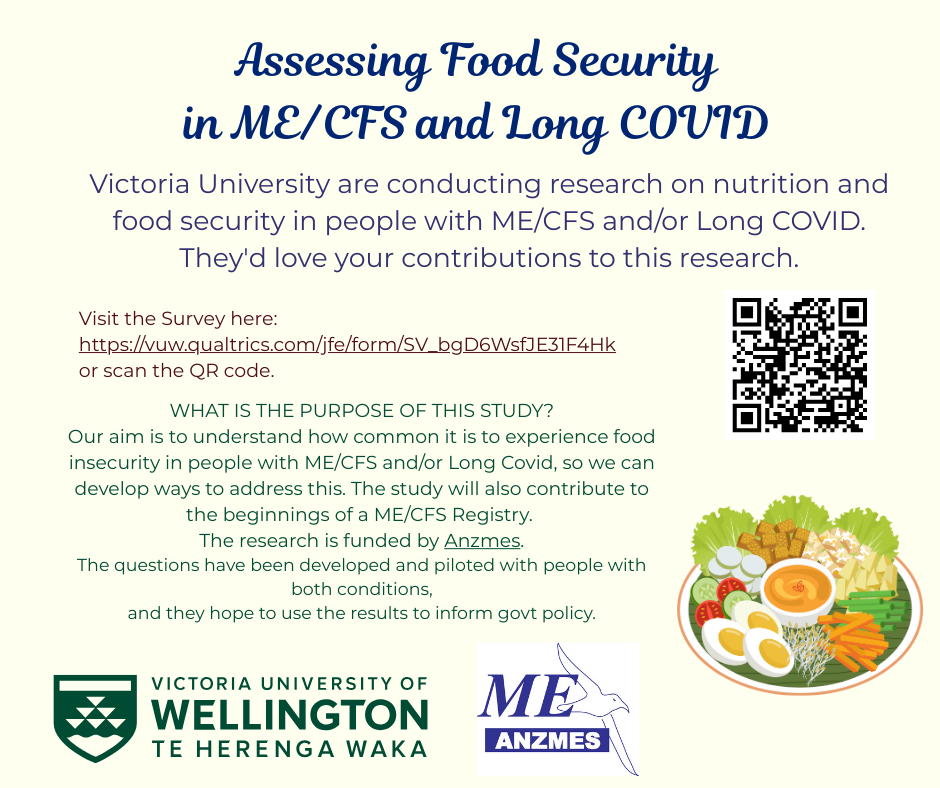
Food Security Research

Read more about this study here: https://www.wgtn.ac.nz/health/about/news/funding-awarded-for-study-on-food-insecurity-among-individuals-with-chronic-health-conditions

Visit the Survey here: https://vuw.qualtrics.com/jfe/form/SV_bgD6WsfJE31F4Hk

ANZMES Announces Third Year of Grant and Scholarship Programme to Propel ME/CFS and Long COVID Research in 2025

Photo Credit: Pixabay/user_id:143740 – jarmoluk-laboratory-2815641_1280.

FOR IMMEDIATE RELEASE

ANZMES, Aotearoa’s National Advisory on Myalgic Encephalomyelitis/Chronic Fatigue Syndrome (ME/CFS), is proud to announce the launch of its 2025 Grant and Scholarship Programme for postgraduate students and academic researchers. The programme is aimed at supporting students who are interested in researching ME/CFS and long COVID. Marking the third consecutive year of this vital initiative, the programme continues its dedicated support for groundbreaking research into ME/CFS and the overlapping challenges of Long COVID within New Zealand.  

ME/CFS is a debilitating chronic condition involving overwhelming ongoing fatigue. Although millions of people suffer with the illness worldwide there is remarkably little research or funding available. 

ANZMES urges postgraduate students and academic researchers across Aotearoa to consider applying for the 2025 Grant and Scholarship Programme.

Fiona Charlton, ANZMES President, states, “As we enter the third year of our Programme, we are incredibly encouraged by the calibre of research from our previous recipients. The funding we are offering can provide crucial support for innovative projects, helping to pay for fees, study, living, or laboratory expenses, and ultimately improving the lives of those affected by these conditions.”

The 2024 recipients included:

  • Associate Professor Mona Jeffreys and Kahurangi Dey from Victoria University of Wellington, who were awarded a $25,000 grant for their project, “Exploring the Prevalence and Determinants of Food Insecurity in People with ME/CFS and/or Long COVID.” Their work also aims to contribute to an ME/CFS Registry in New Zealand.  
  • Melissa Blanc from Auckland University of Technology, received a $5,000 scholarship for her systematic review titled, “Exercise in ME/CFS Patients: Helpful or Harmful?” This research addresses the ongoing debate surrounding exercise recommendations for ME/CFS patients.  
  • Beth Hobbs from Victoria University of Wellington, was awarded a $5,000 scholarship for her project, “Psychological Support for ME/CFS Patients in Canterbury,” focusing on improving patient outcomes, particularly for those who are housebound.  

The impact of this programme extends beyond a single funding cycle. Illustrating the progression of research fostered by ANZMES, Dr. Nicholas Bowden of the University of Otago, a 2023 grant recipient, has recently had his significant study on the experiences of individuals with ME/CFS in New Zealand submitted for peer review to BMC Public Health. This demonstrates the tangible contributions ANZMES-funded research is making to the broader scientific discourse. Read more here: Study provides data on life with ME | Otago Daily Times Online News

For the 2025 funding round, ANZMES is pleased to offer substantial support for researchers dedicated to advancing our understanding of ME/CFS and its intersection with Long COVID. The programme includes:  

Two grants are being offered for postgraduate studies or academic research in either the Faculty of Science, Faculty of Medical and Health Sciences, Faculty of Public Health, or Faculty of Sport and Exercise Science to contribute towards the costs of laboratory analysis or for a research project on ME/CFS or ME/CFS and long COVID. Up to $25,000 per Grant may be awarded.

Four scholarship awards (up to a value of $5,000 each) will be offered to students to contribute towards the expenses of studying for a postgraduate degree in the Faculty of Health Sciences, Public Health or Humanities/Social Sciences for a student who can demonstrate financial project cost requirements or study expenses and who are conducting study/research on ME/CFS or ME/CFS and Long COVID.

Our funding programme is made possible by the support of our members.

Applicants will be selected by ANZMES on the recommendation of their Scholarships Committee.

Applications for 2025 opened 31 May and close on 31 July 2025.

Further information and application forms are available at:

Press Release – ANZMES Awards $25K Grant and $10K in Scholarships to Advance ME/CFS and long COVID Research 2024

For Immediate Release – 8/10/2024

The Associated New Zealand Myalgic Encephalomyelitis Society (ANZMES) is delighted to announce the recipients of their 2024 Research Grant and Scholarship Programme. ANZMES, the leading National Advisory on ME launched the programme in 2023 to support groundbreaking research into Myalgic Encephalomyelitis/Chronic Fatigue Syndrome (ME/CFS) and long COVID. The programme can offer two $25,000 research grants to postgraduate students and academic researchers, specifically aimed at advancing laboratory-based studies. In addition, four $5,000 scholarships are available to support students undertaking ME/CFS and long COVID research in fields such as Health Sciences, Public Health, and Humanities. The programme is designed to foster a new generation of researchers and contribute vital knowledge to these under-researched conditions, which affect millions globally​​.

“This is our second year offering the programme, and we are very pleased to have received strong scholarship applications this year. We encourage postgraduate students to consider their Masters/PhD topics now, for next year’s funding round. In programmes with relatively low costs, scholarships can be used to help pay fees or study and living expenses,” says Fiona Charlton, ANZMES president.

This year, ANZMES has selected three outstanding researchers whose innovative projects will contribute to the growing body of knowledge in this field. Each recipient has been awarded significant funding to pursue their work, advancing ME/CFS and long COVID research in critical new directions.

Meet the 2024 Grant and Scholarship Recipients:

Associate Professor Mona Jeffreys and Kahurangi Dey
Victoria University of Wellington
Project: Exploring the Prevalence and Determinants of Food Insecurity in People with ME/CFS and/or Long COVID
This study, conducted in partnership with research candidate Kahurangi Dey, investigates food insecurity among individuals with ME/CFS and long COVID. The project will not only quantify the prevalence of food insecurity but will also contribute to the creation of an ME/CFS Registry in New Zealand, a vital resource for future research​.

“We are delighted to have been awarded a research grant from ANZMES. For many decades, research into ME/CFS has been overlooked, and these grants fill an important gap. Our research explores aspects of food insecurity in people with ME/CFS and Long Covid. Kahurangi is an expert in kai research, and Mona an expert in Long Covid, as well as living with ME/CFS. Of interest to us are the complexities and interrelationships between food access and utilisation for people living with chronic illnesses. We will be designing and distributing an online survey about food insecurity and barriers that people with ME/CFS and Long Covid face. Respondents will also be asked if they would like to be included in an ME/CFS Registry – it is essential that we start to count how many people are living with ME/CFS.” – Mona and Kahurangi

Melissa Blanc
Auckland University of Technology
Project: Exercise in ME/CFS Patients: Helpful or Harmful? A Systematic Review
Melissa Blanc’s systematic review aims to evaluate the safety and efficacy of exercise programmes for ME/CFS patients. With ongoing controversy regarding exercise as a treatment for ME/CFS, this research will address potential harms and benefits to ensure that exercise recommendations are based on high-quality evidence​.

“It is exciting to be selected for this scholarship. I hope this systematic review will be a valuable contribution to the body of evidence on the topic of exercise use in ME/CFS patients, and that it will help to improve the quality of life of ME/CFS patients.” – Melissa

Beth Hobbs
Victoria University of Wellington
Project: Psychological Support for ME/CFS Patients in Canterbury
Beth Hobbs, is applying to become a registered psychology intern to work with people and will eventually be working with ME/CFS patients in Canterbury to provide critical psychological services. This project focuses on the impact of long-term illness and psychological support to improve patient outcomes, with a particular emphasis on housebound patients​.

“Becoming a psychologist in the field of health has been a long-standing passion of mine. I feel incredibly honoured to have received the ANZMES Scholarship. The scholarship is intended to be used towards funding psychology registration training and an internship working directly with those experiencing symptoms of ME/CFS in Canterbury. ME/CFS has always been a strong focus in my work and study, which has strengthened with the rise of Long COVID. The negative psychological and emotional effects of ME/CFS can cause significant distress for the individual and their whānau, and deeply concerns the ME/CFS community. It will be an absolute privilege to work towards ameliorating people’s distress and assist those living with this challenging condition to enjoy a better quality of life and sense of self. My sincere gratitude to ANZMES for this opportunity!” – Beth

Associate Professor Mona Jeffreys and Kahurangi Dey (co-applicants) will receive a $25,000 grant, while Melissa Blanc and Beth Hobbs will each receive $5,000 scholarships to support their work.

ANZMES President, Fiona Charlton, expressed her excitement about the calibre of this year’s recipients “Each year, we are inspired by the dedication and innovation of our researchers. This year’s recipients not only highlight the urgent need for more research into ME/CFS and Long COVID but also embody the promise of future breakthroughs. We are proud to support their vital work.”

ANZMES continues to lead the charge in supporting vital research that seeks to improve the lives of those affected by ME/CFS and long COVID. Applications for next year’s grants will open in May 2025.

ME/CFS is a complex, debilitating, and often misunderstood medical condition, affecting millions of people worldwide, including at least 25,000 in New Zealand. Despite its widespread impact, there is remarkably little research or funding available.

This ANZMES funding programme was made possible by the generous support of members.

The Grant was awarded by ANZMES on the recommendation of their Grants and Scholarships Subcommittee.

Next year’s funding applications open 31st May 2025.

Visit anzmes.org.nz  for more information, grant regulations, and application forms.


What is ME/CFS?

Myalgic Encephalomyelitis (ME), also known as Chronic Fatigue Syndrome (CFS), is a complex, chronic illness which affects multiple body systems, including the neurological, immune, and endocrine systems. It manifests through a variety of symptoms such as profound exhaustion, cognitive dysfunction, muscles and joint pain, unrefreshing sleep, headaches, sensory issues, and more. These symptoms are not alleviated by rest and are exacerbated by physical or mental activity. Prevalence in Aotearoa/NZ is estimated due to insufficient coding and tracking in the health system. Prorated overseas data (pre-pandemic) suggests that there were at least 25,000 people living with ME/CFS, that’s 1 in 250 adults and 1 in 134 youth. Based on US medical insurance claims, the NZ figure is more likely to be 45,000. With up to fifty percent of long COVID cases meeting the diagnostic criteria for ME/CFS these numbers will rise exponentially. ME/CFS is currently classified as a “chronic illness” rather than a disability in New Zealand, which poses significant challenges for policy recognition, support services, and funding. As a consequence, the lack of awareness and education among healthcare professionals leads to inaccurate patient diagnosis, and ineffective treatment and management plans.


Who is ANZMES?

We are the National Advisory on ME/CFS (and associated conditions) in Aotearoa/New Zealand. With four decades of knowledge and experience, we are the trusted leaders in ME/CFS research, representation, and education. Our expertise comes from a reputable medical team of advisors, including a world renowned expert and MNZM recipient, a fellow of the Royal NZ College of General Practitioners (RNZCGP) and a network of academic researchers, clinicians, and representatives from the ME/CFS community. The executive committee comprises experts in their respective fields for governance, policy, leadership, representation, and education.

Always a trail-blazer, it was the first ME charity of its kind in the world, established in 1980, as ANZMES, to provide support, information dissemination, and representation, achieving past outcomes through dedication, passion, time, and knowledge of lived experience. Today, the organisation

leads as a Royal New Zealand College of General Practitioners (RNZCGP) Continuing Medical Education (CME) Registered Provider, proud funder of vital research, and steward of the community voice. We continue to disseminate evidence-based best practice. We represent the ME/CFS voice nationally in our advisory capacity, and globally through advocacy and leadership, as a founding member of the World ME Alliance.

ANZMES Grant and Scholarship Programme to Boost ME/CFS and long COVID Research for 2024

ANZMES, New Zealand’s national advisory body for Myalgic Encephalomyelitis/Chronic Fatigue Syndrome (ME/CFS), is pleased to announce our grant and scholarship programme is now open for the second time for postgraduate students and academic researchers. The programme is aimed at supporting students who are interested in researching ME/CFS and long COVID.

There will be six funding opportunities awarded each year to Postgraduates who undertake research that furthers understanding, treatment, or prevention of ME/CFS and long COVID, including two $25,000 grants to support laboratory research studies and four $5,000 scholarships to support students undertaking research projects. Academic researchers can also apply for the grants.

ME/CFS is a debilitating chronic condition involving overwhelming ongoing fatigue. Although millions of people suffer with the illness worldwide there is remarkably little research or funding available. 

ANZMES President, Fiona Charlton, says “we are excited to offer this programme again for the second year after starting it in 2023. This programme, aims to support the next generation of researchers and innovators to build a vital source of New Zealand based research, contributing to knowledge and scientific progress that will benefit the community.

“Promoting and investing in ME/CFS-focussed research is a core objective of the organisation. Our funding programme is made possible by the support of our members.”

Two grants are being offered for postgraduate studies or academic research in either the Faculty of Science, Faculty of Medical and Health Sciences, Faculty of Public Health, or Faculty of Sport and Exercise Science to contribute towards the costs of laboratory analysis for a research project on ME/CFS or ME/CFS and long COVID.

Four scholarship awards will be offered each year to students to contribute towards the expenses of studying for a postgraduate degree in the Faculty of Health Sciences, Public Health or Humanities/Social Sciences for a student who can demonstrate financial project cost requirements or study expenses and who are conducting study/research on ME/CFS or ME/CFS and Long COVID.

Applicants will be selected by ANZMES on the recommendation of their Scholarships Committee.

Applications for 2024 awards open 31 May and close 31 July 2024.

Further information and application forms are available at https://anzmes.org.nz/research-grants-and-scholarships-programme

NICE Revisions backed by evidence

In this article:


The NICE Revisions Explained

The  National Institute for Health and Care Excellence (NICE) guidelines are the principle clinical guidance for the UK, and are utilised by many other countries, including Aotearoa/New Zealand. In October 2021, the NICE released revised guidelines for the diagnosis, treatment, and management of Myalgic Encephalomyelitis (ME) / Chronic Fatigue Syndrome (CFS).1

The publication of these guidelines represents a significant opportunity to correct historic misinformation about ME/CFS, and to ensure educators and clinicians have current, methodologically-sound evidence to guide their understanding of pathophysiology, assessment, and management.  

Revision of the ME/CFS NICE guidelines occurred over several years (2017-2021) and followed the standard robust NICE review processes. This included evaluation of the research evidence using the GRADE framework, a widely adopted system for formulating clinical practice recommendations.  Analysis of the evaluation was then conducted by a panel of clinicians and lay persons, followed by review by the NICE guideline committee. The Committee was chaired by Clinical advisor and paediatrician Dr. Peter Barry and Vice Chair Baroness Finlay, Consultant in Palliative Medicine, Clinical Lead for Palliative Care for Wales.

The major changes in the NICE guidelines for ME/CFS are: 

  • Acknowledgement of the cardinal diagnostic symptom of Post Exertional Malaise (PEM), a worsening of symptoms after activity. 
  • The removal of Cognitive Behavioural Therapy (CBT) and Graded Exercise Therapy (GET)  as recommended treatment 
  • The recommendation that Lightning Process should NOT be used to treat ME/CFS 
  • Treatment focus is on symptom management.
summary of recommendation available on NICE website

The historical use of Cognitive Behavioural therapy (CBT) and graded exercise therapy (GET) as a treatment for ME/CFS stemmed from an inaccurate formulation that psychological factors are key in the causation and/or maintenance of symptoms. The risk to people with ME/CFS was that cognitive behavioural techniques urged people to view their symptoms as exaggerated illness behaviours and to counter this by engaging in increasing levels of activity/exercise. Exceeding the energy envelope risks Post Exertional Malaise (PEM) and can result in a prolonged or permanent worsening of the condition.

As evidence of the pathophysiology underlying ME/CFS has mounted, and the potential for harm of CBT and GET has become clear, CBT/GET has been abandoned as a treatment strategy in the USA and many other countries. Major guidance publications have either dropped all reference to these and related therapies, or cautioned against the use of them (e.g. CDC, IoM/NAM).
The 2021 publication of the NICE guidelines likewise clarified that there is insufficient evidence for the use of CBT and GET and removed the recommendation.
The NICE review process also discredited the validity of research included in the 2007 NICE guidelines that claimed these strategies were safe and effective. Evaluations of the quality of evidence used in 2007 to develop these claims, determined that across 172 individual CBT outcomes, as examined across multiple studies, all evidence cited for CBT was found to be of “low” or “very low” methodological quality. Similarly across 64 individual GET outcomes, all evidence for GET was of “low” or “very low” quality. 

The NICE committee took the scrutiny of evidence for psychological therapies a step further by singling out the Lightning Process for additional evaluation. This is a programme, developed by a UK osteopath, that promotes a rudimentary neurolinguistic programming technique as curative of a range of conditions, primarily ME/CFS, and more recently long Covid. The concerns around this programme stem from the formulation that ME/CFS symptoms are a learned response to stress and that alternate responses need to be rewired.  This can result in people engaging in actions that precipitate Post Exertional Malaise thus worsening their condition. The NICE Committee found available evidence for the Lightning Process to be of “very low” quality upon review and now recommends that the Lightning Process not be offered to people with ME/CFS. Furthermore, the British Standard Advertising Authority took legal action against the Lightning Process owners, citing false advertising due to unsubstantiated claims. This action was upheld.

In spite of a lack of evidence for CBT/GET and other therapies such as Lightning Process, there are influential academic and clinical groups in the UK and some European countries, who continue to promote and research psychological interpretations of ME/CFS. In New Zealand, in the face of a proliferation of evidence showing a pathophysiological basis for symptoms, and growing numbers of people being diagnosed with ME/CFS following PASC (long covid), some clinicians in New Zealand remain unaware of this evidence and potential harm, and continue to promote psychological therapies as curative. This is in spite of The Ministry of Health’s recognition of  ME/CFS as biomedical in 2002, and removal of CBT/GET in the clinical advice in the regional Health Pathways in New Zealand from 2019.

In December 2022, the Ministry of Health supported the conclusions of the guidance for ME/CFS published by NICE (2021) saying ‘that ME/CFS is a serious and complex medical condition/disease with varying severity rather than a mental health condition and that there is not a primary psychological basis underlying its development and/or maintenance.’

The NICE Guidelines (2021) now include best practice recommendations for treatment focussing on symptom management and emphasise the importance of energy management techniques, such as pacing, that are proven to be effective in preventing or minimising Post Exertional Malaise (PEM) – the diagnostic characteristic of ME.

“The keys to pacing are knowing when to stop and rest by listening to and understanding one’s own body, taking a flexible approach and staying within one’s limits; different people use different techniques to do this.” – NICE Guidelines 

Final words

ME/CFS is a complex, debilitating condition and best practice care involves a person-centred approach where symptom management is the key to controlling the fluctuating relapse and remittance that occurs. Evidence-based strategies that are shown to be effective are pacing and energy management, and symptom management strategies including a care and support plan, good nutrition, specialist physiotherapy, rest, sleep and pain management.

ANZMES considers the 2021 NICE guidelines to be comprehensive, evidence-based, and backed by a rigorous review process.  We encourage all healthcare professionals, medical bodies, medical schools, and ministry staff (in particular MoH, MSD) in New Zealand to update their understanding of ME/CFS and to become acquainted with the 2021 NICE guidelines.  

It’s one of the biggest challenges in clinical practice in medicine or psychology to try to work with somebody for whom you have no answers, you have no magic bullets. So it is disappointing but one of the reasons we have maybe a shortage of evidence-based treatments for this condition is because of the emphasis on cognitive behavioural therapy and GET … the research is very behind on where it would be if there was actually a level playing field to begin with.
The unfair emphasis on these treatments has created this deficit of knowledge. You have to manage the symptoms of this condition … but to use that as some kind of rationale for retaining therapies that we know are ineffective, doesn’t follow logically.

Professor Brian Hughes, BA, EdM, PhD, Psychology Professor NUI Galway.2

If you are a medical professional or member of a medical body or ministry staff member who would like to know more about ME/CFS, including the up-to-date scientific research, and evidence-based treatment options, please contact ANZMES.

Download the pdf of the NICE Guidelines for ME/CFS.

Or visit their website:

https://www.nice.org.uk/guidance/ng206


World ME Alliance responds to opinion piece

In July 2023 an article titled “Anomalies in the review process and interpretation of the evidence in the NICE guideline for chronic fatigue syndrome and myalgic encephalomyelitis” was published in the Journal of Neurology and Neurosurgery and Psychiatry (JNNP).

The World ME Alliance provided a rapid response to the article which the JNNP chose not to publish.

The World ME Alliance, of which ANZMES is a founding member, is a global collective of national organisations with 27 member organisations (24 at the time of the rapid response).

The full response can be read on the World ME Alliance website.


JNNP publishes detailed NICE response article

On March 1st, 2024, the Journal of Neurology and Neurosurgery and Psychiatry (JNNP) published a full article from authors of the NICE guideline on #MECFS, clearly laying out how this guideline is a rigorous and accurate assessment of current knowledge. Through this, the authors demonstrate the reliability and importance of the recommendations on care for people with ME.

Read the full article here: https://jnnp.bmj.com/content/early/2024/02/28/jnnp-2023-332731


1https://www.nice.org.uk/guidance/ng206/resources/myalgic-encephalomyelitis-or-encephalopathychronic-fatigue-syndrome-diagnosis-and-management-pdf-66143718094021
2Professor Brian Hughes interview minute 19.09: https://view.pagetiger.com/me-fibro-webinars/1

National Advisory on ME releases Best Practice Guidance with clinician and researcher support.

The Aotearoa/New Zealand National Advisory on ME (ANZMES) has released best practice guidance for the diagnosis and management of Myalgic Encephalomyelitis / Chronic Fatigue Syndrome. There is a call for national guidelines to be developed in consultation with ANZMES, to ensure only the latest evidence-based research and data is adopted and used by the health profession. New Zealand-based and international reputable ME/CFS and long COVID researchers and clinicians have signed their names in support of this newly released guidance. The document has been sent to the relevant health associations, medical bodies, and medical schools. The document can be seen below:

The words with best practice written with chalk and images of light bulbs one is yellow the rest are white

Executive Summary

Introduction

As the National Advisory on Myalgic Encephalomyelitis (ME), we present the latest updates to best practice international guidelines for immediate use to standardise care in New Zealand.  This document highlights the critical importance of adhering to current, evidence-based recommendations, incorporating expert consensus for the diagnosis and management of ME while moving away from practices that have been proven to be harmful or disproven by contemporary research.

Overview

Advances in research have evolved our understanding of ME, refining diagnosis criteria and symptom management. Research now shows clearly that the basis of ME is biomedical rather than psychological, with multi-systemic dysfunction driving pathogenesis and symptom progression. Guidelines for clinical practice reflect this understanding.

Key practice points:

  • The  Institute of Medicine (2015) Criteria are the preferred diagnostic criteria for ME.
  • The Canadian Consensus Criteria are the preferred criteria in research for ME.
  • International guidelines from institutions like the Mayo Clinical Proceedings, Centers for Disease Control and Prevention (CDC), and National Institute of Health and Care Excellence (NICE) provide an up-to-date framework for healthcare professionals to navigate the complexities of symptom management in ME.
  • International guidelines uniformly advocate a multidisciplinary approach,  emphasising the identification and management of the cardinal symptom – Post-Exertional Malaise (PEM).
  • Symptom management is the focus of treatment with emphasis on pacing – a free energy management technique used to avoid PEM. Ignoring these guidelines can worsen a patient’s condition.
  • Robust review of evidence has led to the removal of three previously recommended treatments from international guidelines – Cognitive Behavioural Therapy (CBT), Graded Exercise Therapy (GET), Lightning Process. Continuing to perpetuate the prescription of these treatments may cause harm.

International best practice guidelines play a crucial role in standardising care and improving patient outcomes. We are committed to supporting best practice care for people with ME and we offer resources, training and access to up-to-date guidelines that can assist in aligning NZ medical practice with the latest robust, evidence-based recommendations.

Best Practice Guidelines 

Presented below are the most current evidence-based, reputable international guidelines for the diagnosis and management of ME (also known as Chronic Fatigue Syndrome (CFS) and long COVID.

The landscape of healthcare is constantly evolving, with new research findings and innovative approaches emerging regularly. It is imperative that healthcare professionals stay informed about the latest evidence-based practices and incorporate them into daily routines, therefore enhancing the quality of care provided and ensuring the safety and well-being of patients.

There are longstanding practices that have been widely accepted in the past but have since been debunked or found potentially harmful. It is crucial that we collectively reevaluate and abandon these practices when necessary to prevent harm.

We would like to see national guidelines for New Zealand that follow international guidelines in both primary and secondary care. Standardising care with best practice guidelines eliminates the current postcode lottery for care occurring in our country, and ensures that every individual with ME/CFS, long COVID, and their common comorbidities, is dealt with appropriately, using the latest evidence-based information.

ANZMES has already produced two one-page documents covering pertinent information needed in primary care for diagnosis and management of ME/CFS and long COVID, and will produce guidelines for secondary care in due course.

The appropriate international guidelines for the diagnosis and management of ME are:

  • The Institute of Medicine 20151
  • Canadian Consensus Criteria (CCC)/International Consensus Criteria (ICC)2
  • Mayo Clinic Proceedings3
  • Centre for Disease Control and Prevention (CDC)4
  • National Institute for Health and Care Excellence (NICE)5

Why follow these Guidelines over others? 

Diagnosis

Definitions and diagnosis of ME have advanced as clinical and biomedical understanding of the condition has increased and this is reflected in these guidelines. Over 20 different case definitions have been published with many containing inconsistencies between research and clinical criteria.  

In the past ME was misunderstood and physicians often labelled it as a psychological illness or a form of stress-induced fatigue. Excessively inclusive and inconsistent definitions and criteria initially created misconceptions about ME and led to negative experiences for people seeking diagnosis. For example, in 1991, a group of predominantly psychiatrists published criteria designed for research. This criteria was used for the PACE trial. They recognised a subgroup of people with chronic fatigue present with symptoms after infection. However, they did not exclude those with depression and anxiety, and factored this into the symptom definitions as “mood disturbance.” This has contributed to research in which participants may have had a mental health disorder causing fatigue, rather than ME.6 

As biomedical understanding has increased the diagnostic criteria have evolved,  in particular, to now recognise the multi-systemic nature of the condition and the impairment of the energy and recovery systems that result in Post Exertional Malaise (PEM).

The Institute of Medicine Criteria (IoM) and the International Consensus Criteria (ICC) are currently the most robust diagnostic criteria for clinicians. These set out three primary symptoms that must be present, for a minimum of six months to diagnose ME – PEM, unrefreshing sleep, and unexplained fatigue. At least one other additional symptom must be present – either orthostatic intolerance or cognitive impairment.  Functional impairment must be substantial, with ICC requiring 50% decrease in activity. Case definitions and criteria that do not include PEM, such as Fukuda 19947 are therefore now less commonly used in practice.

The International Consensus Criteria (ICC) was developed as a diagnostic tool for clinicians based on the Canadian Consensus Criteria (CCC). The CCC is considered the strictest criteria and is primarily used in research, superseding Fukuda.

When assessing a patient with a multitude of symptoms the IoM* criteria provide clarity in this process by offering a concise set of required symptoms. The IoM criteria published most recently (2015) are now widely considered to be the best tool for use in clinical settings as they offer a clearer definition than previous guidelines and emphasise the importance of the patient’s subjective experience and the need for thorough case taking and examination. The IoM (2015) can be used for both adults and children.

*IoM is now renamed National Academy of Medicine (NAM).

Symptom Management

Current best practice guidelines from robust unbiased reviews emphasise that all treatment needs to be offered in a way that avoids PEM and recommends that energy expenditure is managed within individual limits. Pacing for people with PEM has been shown to improve quality of life, fatigue severity, and physical functioning.8,9

What is PEM?

Post-Exertional Malaise is the worsening of ME or long COVID symptoms after physical or mental effort and this can happen one or two days after even minor activity.  PEM is also referred to as Post-Exertional Symptom Exacerbation (PESE) and Post-Exertional Neuroimmune Exhaustion (PENE). People with ME describe PEM as “crashing” or “collapsing” with relapse of symptoms.  It is helpful to understand that normally if a person is fatigued after exertion they will rest and then energy will be restored, in ME this physical recovery process is dysfunctional. Studies have identified differences in gene expression, blood volume and oxygen consumption, and mitochondrial function as some potential drivers for this dysfunction. Dysfunction of the regulatory control network within and between the nervous systems is also believed to contribute to the pathophysiology of PEM, which can impact all body systems.10,11 The most common symptoms associated with a PEM flare include body aches, pain, weakness, fatigue, cognitive dysfunction, and orthostatic intolerance.

What is Pacing?

Pacing is an energy management technique that can be used to help with symptoms related to PEM. Patients are encouraged to stay within their energy envelopes and gradually increase their activity levels over time if possible, while being mindful of their limits and symptoms.  The International Consensus Primer12 highlights the importance of patients learning to become aware of their bodies’ early warning signs that they are beginning to push themselves outside their limits. Useful tools include heart rate monitors, step counters, and temperature monitoring. For example, changes in heart rate (above anaerobic threshold) and reduction in body temperature can be early signals of overexertion.

There are three treatments that are not recommended for ME by international best practice guidelines or have been removed from said guidelines (Mayo Clinical Proceedings, and CDC):

  • Cognitive Behavioural Therapy (CBT)
  • Graded Exercise Therapy
  • Lightning Process 

Why is Cognitive Behavioural Therapy Contraindicated as Treatment for ME?

Cognitive Behavioural Therapy (CBT) is not recommended as a treatment for ME by leading experts and organisations (CDC, Mayo Clinic) and is specifically contraindicated in international guidelines. These strategies do not recognise or address the underlying pathophysiological issues.13

While psychological approaches can be supportive they are not evidenced as treatments of the condition.14 There is no evidence to show that CBT can “cure” the physiological and cognitive impairment symptoms of ME and research has been offered to the media in a misleading context, which has led to an exaggerated perception of effectiveness.15 Further independent review has found that “the arguments that are used to claim that NICE was wrong, in reality, highlight the absence of evidence for the safety and efficacy of CBT and GET and strengthen the decision by NICE to drop CBT and GET as curative treatments for ME/CFS.”16

“When you develop therapies based on this psychogenic cognitive-behaviour theory, these therapies do not work, which raises the question of whether the theory works.”
Professor Brian Hughes, BA, EdM, PhD, Psychology Professor NUI Galway

The Mental Health and Addiction division of Manatū Hauora / Ministry of Health clearly stipulates that ME is a complex medical condition rather than a mental health condition (December 2022).

The NICE October 2021 guidelines (1.12.28) states that CBT may be useful to help people with ME/CFS “manage their symptoms, improve their functioning and reduce the distress associated with having a chronic illness” but that clinicians must explain the principles of CBT, including any potential benefits and risk, that it ‘may help’ but ‘it is not curative.’ This paragraph was added on 20/10/2025.

The pathophysiology of ME and Post Exertional Malaise (PEM)

The evidence for the pathophysiology underpinning ME,17 the harm that can result from PEM18 and the value of pacing as a primary strategy has proliferated in the past decade. Speculative theories of ME being associated with deconditioning, exercise avoidance, a somatic perception disorder, or unresolved trauma have been discredited.19,20 This shift from speculation to evidence is now reflected in numerous examples of peer-reviewed research, and in all reputable international guidance. 

Research in New Zealand, under Emeritus Professor Warren Tate and clinician Dr Rosamund Vallings (MNZM) offers insight into the biomedical basis identifying molecular changes in ME patients, including dysfunction of the autonomic nervous system, immune regulation, energy production and lowered general metabolism.21 Dysfunction of the regulatory control network within and between the nervous systems is also believed to contribute to the pathophysiology of PEM, which can impact all body systems.22,23 Further research suggests that PEM may be caused by an overactive immune response, leading to increased inflammation in the body. In a study published in the Journal of Translational Medicine, researchers found that ME patients with PEM and higher levels of pro-inflammatory cytokines in their blood, pointing to a potential immunological pathway.24 

In December 2022, the Ministry of Health supported the conclusions of the guidance for ME published by NICE (2021) saying ‘that ME/CFS is a serious and complex medical condition/disease with varying severity rather than a mental health condition and that there is not a primary psychological basis underlying its development and/or maintenance’.25

Why is Graded Exercise Therapy Contraindicated for ME?

Numerous reputable studies and guidelines including the IoM, NICE, Mayo Clinic and the CDC have removed Graded Exercise Therapy (GET) from treatment recommendations due to the potential that this strategy will elicit Post Exertional Malaise (PEM). This potential for harm extends to patients with Long COVID who experience Post Exertional Symptom Exacerbation (PESE), similar to PEM. 

Guidance that recommends CBT and GET has been withdrawn and replaced with pacing and aligned strategies:

  • The large 2011 PACE randomised trial26 which recommended GET and CBT has been robustly reviewed and discredited.27  Activities carried out as part of the PACE trial differ from what is considered “pacing.” Pacing is explained earlier in this document.
  • The Centers for Disease Control and Prevention removed CBT/GET from the treatment guidelines in 2017.28
  • Recommendation for CBT/GET originated from the 2007 NICE guidelines. However, these recommendations have now been withdrawn as they were based on nine (9) studies (4 CBT, 5 GET) each of which had significant methodological limitations. The 2021 NICE guidelines,29 DO NOT recommend CBT/GET and are based on 172 CBT and 64 GET study outcomes, which factored methodological limitations into the analysis. Arguments against the NICE review have been found to further highlight the lack of evidence of safety and efficacy for CBT and GET.30 Enclosed please find an explanation of the 2021 NICE review.
  • Consensus Recommendations31 published by Mayo Clinical Proceedings, in November 2021, recommended pacing as an individualised approach to energy conservation and management that can minimise the frequency, duration, and severity of PEM. In October 2023, Mayo Clinical Proceedings published a Concise Review for Clinicians for ME.32 This provides clear management advice stating that “Symptom-contingent pacing is recommended to all patients with ME/CFS.” 
  • The CDC and 2007 [and 2021] NICE guidelines cite pacing as an effective component in the treatment of patients with ME.
  • In 2019 and 2020, most Regional Health Pathways teams, in New Zealand, updated their clinical guidance for ME to reflect the IOM 2015 diagnostic criteria and the CDC’s recommendation to offer pacing rather than GET. 
  • Workwell foundation, a group of experts and researchers that work with fatigue-related illnesses, such as ME and Long COVID, oppose the use of GET for ME, explaining that GET “aimed at training the aerobic energy system, not only fails to improve function, but is detrimental to the health of patients and should not be recommended….Indications of metabolic dysfunction in ME/CFS suggest that limiting sustained activity whenever possible is a more reasonable therapeutic approach.” The Workwell Foundation’s  full argument and evidence can be found here in their Letter of Opposition to the use of GET for ME.

This also has implications for people with Long COVID as practitioners follow ME management for this condition, due to their similarities. Recent research comparing long COVID and ME/CFS found similarities that included the experience of low and medium physical and cognitive exertion to trigger PEM, symptoms of fatigue, pain, immune reaction, neurologic, orthostatic intolerance, and gastrointestinal symptoms during PEM, rest to recover from PEM, and benefits from pacing to prevent PEM.33 

The current Ministry of Health NZ Clinical Rehabilitation Guideline for People with Long COVID is aligned with ME/CFS management and states that for PEM or PESE: 

graded exercise therapy (GET: planned, regular exercise with incremental increases in frequency and/or intensity, duration and type with a goal to increase fitness) is not recommended for these people, because it can cause an exacerbation of symptoms. Symptom-led pacing is advocated for, this includes prioritising, planning, and use of an activity diary.34

Graded exercise therapy of planned regular exercise, with incremental increases usually utilises heart rate values, however individuals with ME often have chronotropic intolerance and therefore cannot achieve the same values to those individuals without this condition.35

Why is the Lightning Process not recommended for ME?

Best practice guidelines specifically state that the Lightning Process (LP) is not recommended as a treatment for ME, due to a lack of quality evidence and potential harms. 

Proponents of LP quote a single published study of the Lightning Process known as the SMILE trial. This study has been widely criticised for ‘outcome swapping’ as the primary outcome measure was changed from school attendance to scores on a self-report questionnaire. Given that LP overtly encourages patients to only report positive outcomes and improvement in their ability to control symptoms this is likely to lead to response bias. In July 2019, after an investigation by the Archives of Disease in Childhood, a lengthy and detailed editorial correction to the SMILE trial was published.36

The study corrections include, acknowledgement from the authors that the study was not fully ICMJE compliant, with their account of timeline and chronological order and changes being made to the primary outcomes of the study. 

While anecdotal stories indicate that these programmes do improve functionality for some, there are also reports that these programmes cause harm for others. Some people report severe, long term increases in symptoms following participation in these programmes when they have been encouraged to exceed their safe level of exertion. 

The Lightning Process is not cost-effective for many people with ME/CFS who are on low income/government benefits. Pacing, which is a self-management technique, is free, and can be carried out in one’s home. The only cost is if an individual chooses to purchase a wearable to monitor heart rate etc.

The World ME Alliance agrees with the international guidelines and published a position paper stating that: “The World ME Alliance and its members do not endorse the Lightning Process for people with Myalgic Encephalomyelitis (ME), sometimes called Chronic Fatigue Syndrome (CFS).”37

Given the lack of evidence for Lightning Process and aligned programmes, the claims of cure, the lack of informed consent provided to patients around the risk of PEM, and the potential for negative outcomes, it should not be promoted to, or recommended by, health professionals. 

Lived experience

The inclusion of consumers’ lived experiences is essential to the development and evaluation of health service delivery and to making quality improvements in the health system. The Health Quality and Safety Commission (HQSC) identifies that lived experience stories can help highlight where and how services could be improved to meet peoples’ needs. 

Narratives from members of the NZ ME/CFS community in the form of Case Studies have been obtained through the regional ME/CFS organisations to illustrate examples of harm that have occurred through misinformation and treatment recommendations for GET or the Lightning Process. They have not been included in this document as they are not peer-reviewed or published case studies, however these are available upon request.

Potential impact on the health of the community

Continuing to perpetuate these outdated recommendations may lead to harmful practice and teach new health practitioners to continue this. Inconsistencies between New Zealand medical practice teachings and international standards may also lead to confusion for new and emerging practitioners. 

There is great potential for harm because patients with ME who ignore or push through their symptoms can worsen their condition, often becoming bedridden.38 

Doctors with M.E state “Discriminatory practice and standards in research, clinical knowledge, and safety which would not be tolerated in any other disease areas have become normalised in the field of ME/CFS. However such practice is unlawful, harms patients, and generates risk.”39

As any good researcher or clinician should know, basing a theory or treatment regime, on one single study, is not good practice. Especially if the single study is known to be flawed and unreplicated. Studies must have sound methodology, high validity and reliability, and outcomes must be replicable. Even Randomised Control Trials (considered the most robust) can have flaws in methodology that affect outcomes, as demonstrated by the SMILE trial. It is imperative that health professionals and medical associations and schools use the growing body of research and knowledge to support its resources, take note of meta analyses and robust literature reviews, and only publish information that is supported by the evidence.

Using outdated and flawed studies for the basis of treatment programmes for healthcare in Aotearoa/New Zealand will undermine the reputation and authority of New Zealand medical professionals within the eyes of the international medical, clinician, and research communities. It makes it harder for New Zealand health professionals to be taken seriously on the international stage, if the country’s health policies and practices reflect outdated opinions and flawed studies.

The medical profession has a duty to uphold a standard of care that follows the Hippocratic oath of “first, do no harm” and it is vital that all publications produced by health professionals follow these standards, and those that are discredited, harmful, or outdated are removed from circulation. 

We welcome the opportunity to work with you to ensure that any publications disseminated by health professionals or associations, follow the latest reputable research and guidelines. Our team of world-renowned experts are at the forefront of ME/CFS research and clinical practice and as the National Advisory on ME, ANZMES is fully equipped to provide the resources necessary to ensure that only the appropriate information is made available nationwide. Please utilise our expertise, on a subject that we spend 100% of our time researching, analysing, representing, and educating on, to ensure that best practice guidelines are the ONLY guidelines released by any Aotearoa/New Zealand based medical entity or representative.

We look forward to your positive response.

Yours sincerely

Fiona Charlton

President, ANZMES

Organisations in support of this letter:

M.E. Awareness NZ

Complex Chronic Illness Support

ME Support – NZ

MECFS Canterbury

MECFS MEISS (Otago and Southland)

Rest Assured Respite Trust

World ME Alliance

Emerge Australia

The ME Association (MEA)

Solve M.E.

Clinicians and Researchers in support of this letter:

Aotearoa/New Zealand

Emeritus Professor Warren Tate, University of Otago

Dr. Rosamund Vallings, MNZM

Dr. Anna Brooks, University of Auckland

Dr. Sarah Dalziel

Dr. Cathy Stephenson

Dr. Ken Jolly

Dr. Judijke Scheffer

Dr. Lynette Hodges, Massey University

Assoc. Professor Mona Jeffreys, Victoria University

International

Professor Sonya Marshall-Gradisnik, NCNED Professor

Dr. Charles Shepherd, MEA

Professor Leonard Jason, de Paul University

Professor Maureen Hanson, Cornell


References

1 Institute of Medicine of the National Academies. Beyond Myalgic Encephalomyelitis/Chronic Fatigue Syndrome: Redefining an Illness.2015. www.nap.edu/read/19012

2 Carruthers BM, van de Sande MI, De Meirleir KL, Klimas NG, Broderick G, Mitchell, et al. Myalgic Encephalomyelitis: International Consensus Criteria. Journal of Internal Medicine. 2011 doi: 10.1111/j.1365-2796.2011.02428.x. (published online on 20 July 2011)

3 Diagnosis and Management of Myalgic Encephalomyelitis/Chronic Fatigue Syndrome. 2023. Mayo Clinic Proceedings. https://doi.org/10.1016/j.mayocp.2023.07.032

4 Centers for Disease Control and Prevention. (2022). Information for Healthcare Providers. Understanding History of Case Definitions and Criteria. www.cdc.gov/me-cfs/healthcare-providers/case-definitions-criteria.html

5 National Institute for Health and Care Excellence (NICE). (2021). ‘Overview | Myalgic Encephalomyelitis (or Encephalopathy)/Chronic Fatigue Syndrome: Diagnosis and Management | Guidance | NICE’. NICE. https://www.nice.org.uk/guidance/ng206

6 Sharpe, M.C. et. al. (1990) A report – chronic fatigue syndrome: guidelines for research https://www.ncbi.nlm.nih.gov/pmc/articles/PMC1293107/pdf/jrsocmed00127-0072.pdf

7 Fukuda K, Straus SE, Hickie I, Sharpe MC, Dobbins JG, Komaroff A. (1994). The chronic fatigue syndrome: A comprehensive approach to its definition and study. Annals of Internal Medicine. 1994;121:953–959.

8 Jason L, Benton M, Torres-Harding S, Muldowney K. The impact of energy modulation on physical functioning and fatigue severity among patients with ME/CFS. Patient Educ Couns. 2009;77(2):237-241. doi:10.1016/j.pec.2009.02.015  

9 Bested AC, Marshall LM. Review of Myalgic Encephalomyelitis/Chronic Fatigue Syndrome: an evidence-based approach to diagnosis and management by clinicians. Rev Environ Health. 2015;30(4):223-249. doi:10.1515/reveh-2015-0026

10 Tirelli U, Chierichetti F, Tavio M, Simonelli C, Bianchin G, Zanco P, Ferlin G. Brain positron emission tomography (PET) in chronic fatigue syndrome: preliminary data. Amer J Med 1998; 105(3A): 54S-58S. [PMID: 9790483]

11 De Lange F, Kalkman J, et al. Gray matter volume reduction in the chronic fatigue syndrome. Neuroimage 2005; 26: 777-81. [PMID: 15955487]

12 Carruthers B. M. & van de Sande M. I. (2021). Myalgic Encephalomyelitis – Adult & Paediatric: International Consensus Primer for Medical Practitioners.

13  Twisk and Maes (2009) https://pubmed.ncbi.nlm.nih.gov/19855350/

14 Doctors with ME https://doctorswith.me/nice-gp-update/

15 ‘Are the New NICE Guidelines for ME/CFS at Odds with the Research Evidence?’, 14 August 2022. https://www.bmj.com/content/375/bmj.n2647/rr-1.

16 Vink M, Vink-Niese A. The Updated NICE Guidance Exposed the Serious Flaws in CBT and Graded Exercise Therapy Trials for ME/CFS. Healthcare (Basel). 2022 May 12;10(5):898. doi: 10.3390/healthcare10050898. PMID: 35628033; PMCID: PMC9141828.

17 ME/CFS and Long COVID share similar symptoms and biological abnormalities: road map to the literature. 2023. Frontiers in Medicine. doi.org/10.3389/fmed.2023.1187163

18 Treatment Harms to Patients with Myalgic Encephalomyelitis/Chronic Fatigue Syndrome. 2022. Advances in Bioengineering & Biomedical Science Research. DOI: 10.33140/ABBSR.06.01.01

19 Geraghty K, Jason L, Sunnquist M, Tuller D, Blease C, Adeniji C. The ‘cognitive behavioural model’ of chronic fatigue syndrome: Critique of a flawed model. Health Psychol Open. 2019 Apr 23;6(1):2055102919838907. doi: 10.1177/2055102919838907. PMID: 31041108; PMCID: PMC6482658.

20 van Campen CLMC, Rowe PC, Visser FC. Deconditioning does not explain orthostatic intolerance in ME/CFS (myalgic encephalomyelitis/chronic fatigue syndrome). J Transl Med. 2021 May 4;19(1):193. doi: 10.1186/s12967-021-02819-0. PMID: 33947430; PMCID: PMC8097965.

21 Sweetman E, Ryan M, Edgar C, MacKay A, Vallings R, Tate W. (2019). Changes in the transcriptome of circulating immune cells of a New Zealand cohort with myalgic encephalomyelitis/chronic fatigue syndrome. Int J Immunopathol Pharmacol. 33:205873841882040.

22 Tirelli U, Chierichetti F, Tavio M, Simonelli C, Bianchin G, Zanco P, Ferlin G. Brain positron emission tomography (PET) in chronic fatigue syndrome: preliminary data. Amer J Med 1998; 105(3A): 54S-58S. [PMID: 9790483]

23 De Lange F, Kalkman J, et al. Gray matter volume reduction in the chronic fatigue syndrome. Neuroimage 2005; 26: 777-81. [PMID: 15955487]

24  Ghali, A., Richa, P., Lacout, C. et al. Epidemiological and clinical factors associated with post-exertional malaise severity in patients with myalgic encephalomyelitis/chronic fatigue syndrome. J Transl Med 18, 246 (2020). https://doi.org/10.1186/s12967-020-02419-4

25 Letter from Ministry of Health. 19 Dec 2022. https://drive.google.com/file/d/1Mkc7tIfXLcMaWQm63_aGRDhN8dEjSWwj/view?usp=drive_link

26 Comparison of adaptive pacing therapy, cognitive behaviour therapy, graded exercise therapy, and specialist medical care for chronic fatigue syndrome (PACE): a randomised trial. 2011. Lancet. https://pubmed.ncbi.nlm.nih.gov/21334061/

27 Rethinking the treatment of chronic fatigue syndrome—a reanalysis and evaluation of findings from a recent major trial of graded exercise and CBT. 2018. BMC Psychology. https://doi.org/10.1186/s40359-018-0218-3

28 CDC Treating the Most Disruptive Symptoms First and Preventing Worsening of Symptoms, 2021.https://www.cdc.gov/me-cfs/healthcare-providers/clinical-care-patients-mecfs/treating-most-disruptive-symptoms.html

29 National Institute for Health and Care Excellence (NICE). (2021). ‘Overview | Myalgic Encephalomyelitis (or Encephalopathy)/Chronic Fatigue Syndrome: Diagnosis and Management | Guidance | NICE’. NICE. https://www.nice.org.uk/guidance/ng206

30  Vink M, Vink-Niese A. The Updated NICE Guidance Exposed the Serious Flaws in CBT and Graded Exercise Therapy Trials for ME/CFS. Healthcare (Basel). 2022 May 12;10(5):898. doi: 10.3390/healthcare10050898. PMID: 35628033; PMCID: PMC9141828.

31  Myalgic Encephalomyelitis/Chronic Fatigue Syndrome: Essentials of Diagnosis and Management. 2021. Mayo Clinical Proceedings. L Bateman, et al. https://doi.org/10.1016/j.mayocp.2021.07.004

32  Diagnosis and Management of Myalgic Encephalomyelitis/Chronic Fatigue Syndrome. 2023. Mayo Clinic Proceedings. https://doi.org/10.1016/j.mayocp.2023.07.032

33 Vernon, Suzanne D. et al. ‘Post-exertional Malaise Among People with Long COVID Compared to Myalgic Encephalomyelitis/chronic Fatigue Syndrome (ME/CFS)’. 1 Jan. 2023 : 1 – 8.

34  Ministry of Health. 2022. Clinical Rehabilitation Guideline for People with Long COVID (Coronavirus Disease) in Aotearoa New Zealand: Revised December 2022. Wellington: Ministry of Health.

35 Davenport, Todd E. et al. ‘Chronotropic Intolerance: An Overlooked Determinant of Symptoms and Activity in Myalgic Encephalomyelitis / Chronic Fatigue Syndrome. Frontiers Paed. 22 Marc. 2019, 7 https://www.frontiersin.org/articles/10.3389/fped.2019.00082/full

36 Editor’s note on correction to Crawley et al. (2018). http://dx.doi.org/10.1136/archdischild-2017-313375ednote

37 World ME Alliance. 2022. The Lightning Process – A Position Paper. https://worldmealliance.org/wp-content/uploads/2022/08/The-Lightning-Process-A-Position-Paper-by-the-World-ME-Alliance-2022-1.pdf

38 Strassheim, Victoria; Newton, Julia L.; Collins, Tracy (February 5, 2021). “Experiences of Living with Severe Chronic Fatigue Syndrome/Myalgic Encephalomyelitis”. Healthcare. 9 (2): 168. doi:10.3390/healthcare9020168. ISSN 2227-9032. PMC 7914910. PMID 33562474.

39 Doctors with-ME. ”Rights and Obligations in ME/CFS: Overcoming normalised disregard for standards” https://doctorswith.me/rights-and-obligations-in-me-cfs-overcoming-normalised-disregard-for-standards/

ANZMES 2023 AGM Report

The ANZMES AGM was held at 1pm on the 18th November 2023 via ZOOM online meeting.

This was ANZMES 43rd AGM of caring and supporting people with ME/CFS and their whanau and carers, as well as disseminating information, resources, and education to them, the general public, and medical professionals. ANZMES is looking at new initiatives as part of our strategic planning for the next year, and will continue to fund vital research that benefits the ME/CFS community as more physiological evidence is discovered and more understanding of the condition is brought to the fore.

Fiona Charlton (President) opened the AGM Meeting and the President’s report outlined some of ANZMES activities throughout the year. 

Highlights included;

  • This year we are proud to have launched a Grant and Scholarship Programme for postgraduate students and academic researchers. This will be an annual fund for ME/CFS and long COVID study. Two exciting projects are proceeding thanks to the ANZMES Grants of $25,000 each
  • ANZMES launched Know M.E. Series for health professionals providing a monthly newsletter packed full of evidence-based information and research. The associated video podcasts are publicly available. This series is CME accredited by the Royal NZ College of GP’s, and ANZMES is a Registered Provider for continuing medical education. This series features a newsletter covering a different topic each month. Know M.E. also includes a podcast which is publicly available on Spotify, iHeart Radio, Google Podcasts, and iTunes/Apple. The video version is publicly available on YouTube. Each month features special guest interviews speaking about M.E. topics.
  • In May 2023 ANZMES launched two one-page resources for the diagnosis and management of ME/CFS and long COVID in primary care.
  • In early November 2022 we held a long COVID educational event for health professionals. We had over 150 registrants, including GPs, nurses, nurse practitioners, clinic managers, med students, physiotherapists, OTs, and more. Our speakers talked about post exertional malaise and how to avoid it, described the similarities and differences between Long COVID and ME/CFS, how to diagnose both conditions, how to treat through allied health, and the effects of COVID and Long COVID in Māori and Pasifika communities.
  • Dr Sarah Dalziel attending the the 3rd ME/CFS International Conference 2023: RID – Research Innovation and Discovery and provided a summary of the conference.

All present committee member’s have continued their term and were voted on for the upcoming year. The appointments are as follows:

President – Fiona Charlton

Vice President – Ange Robinson

Treasurer – Amy Ma

Reviewer – Alan Shanks

Executive committee – Anna Brooks, Suzanne Duffy, Wendy Matthews, Steve Murray, Gabby Shortt and Ros Vallings.

Heather Wilson who has been on the ANZMES committee for well over 20 years has now stepped down. A very, very special thanks go to Heather for her hard work and time spent on the committee and time spent helping people and their whanau, it is much appreciated. After the AGM was announced closed a presentation was played of Heather’s farewell which was held online and in person in Dunedin on Friday 3rd November 2023.

Dr Sarah Dalziel and Ken Jolly both continue as ex officio Medical Advisor’s to ANZMES. We would like to sincerely thank Sarah and Ken for their time and effort to help answer any queries we may have in the medical field. 

Membership Fees for 2024 have remained unchanged, they are set at:

  • $10.00 for Full membership
  • $5.00 for Concessionary membership
  • $5.00 for Family members
  • A free Helping Hand option will be available for people who suffer severe financial hardship.

After the AGM had finished, Dr Sarah Dalziel gave a presentation on her attendance at the 3rd ME/CFS International Conference 2023: RID – Research Innovation and Discovery. 

YouTube links to the AGM attached below
AGM 2023 – 1 of 3
AGM 2023 – 2 of 3
AGM 2033 – 3 of 3

Malcare WordPress Security