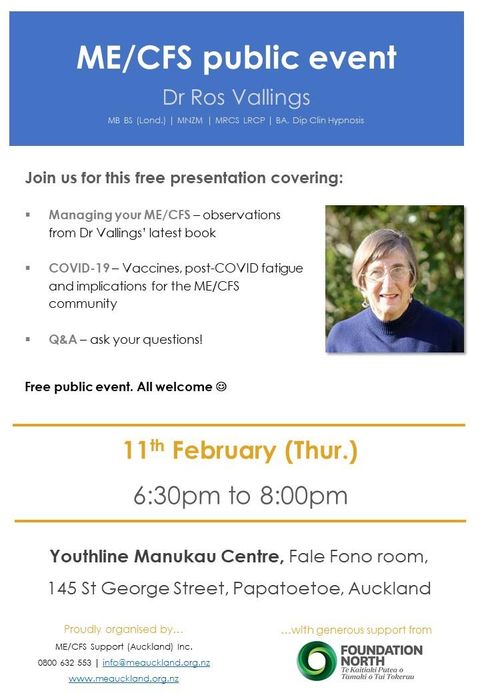
Dr. Ros Vallings is scheduled to discuss COVID-19 and ME/CFS at a public event on 11th February 2021 in Auckland:

All the latest events from ANZMES.
Dr. Ros Vallings is scheduled to discuss COVID-19 and ME/CFS at a public event on 11th February 2021 in Auckland:
ANZMES is supporting Gavin in his project and will be using his work
for awareness raising and to advocate for those with ME/CFS. We thank
Gavin for this opportunity.
I am a photographer working on a portrait series on living with ME/CFS.
For this series, I am looking for people who are willing to sit for a
portrait and talk about how ME/CFS has impacted them.
The purpose of the project is to increase awareness and understanding
of how living with the condition impacts people’s lives in a very real
way.
This series will consist of a portrait series and personal stories of
those living with ME/CFS and will culminate in an online exhibition.
As well as ANZMES having the images and stories for their use as a
resource to further their advocacy work.
My partner lives with ME/CFS so I have an understanding of the
condition and a motivation to increase awareness of it.
If you are interested in being involved and telling your story. Please
don’t hesitate to get in touch
Gavin McGregor
0212774788
gavmc23@mac.com
https://www.gavinmcgregor.com
To be completed and sent in by 15th December 2020
The Survey Link is:
https://www.surveygizmo.com/s3/5728298/ANZMES-Survey-2020
1. It is totally voluntary to complete the survey.
2. Completion of the survey is anonymous and so we will not know who has completed the survey or be able to link a person with their responses.
3. All the responses will be joined together so only group information will be used.
4. The final statistics from the survey will be shared with others. For example it may be shared with the media via a press release. This information will also be used for lobbying.
We are aware that ME/CFS has a large impact in a variety of areas so we could have included many areas in this survey however, we are also aware that completing a long survey would not be possible for many people with ME/CFS so we have not been able to include all the areas.
We would encourage you to complete the survey, as the more people who complete the survey the more notice others will take of the results. If you know others with ME/CFS please encourage them to complete the survey as well.
The results will be summarised in the Meeting Place and on the ANZMES website.

Dr Vallings is speaking in Hamilton at the Methodist Church, corner of Normandy Ave and Bader St, Melville, Hamilton 10.30 to 11.30 on Thursday 13th August 2020.
Please Register by phoning Tracey on 07 8344745 or email tracey@mswaikato.org.nz.
Please arrive at 10.15 for a prompt start. Morning tea provided. A gold coin koha/donation will be greatly appreciated.
Today, 12th of May 2020 is ME Day!
As part of ANZMES awareness raising we are sending out these posters.
Could you please share them far and wide so many people get the message
that ME is an invisible Illness.
You can see a broken leg or arm as you have a cast on but many of the symptoms of ME are invisible and can not be seen.
Sharing these posters helps raise awareness and understanding.
Take Care and be kind to yourselves.
ANZMES Writing and Poetry Competition

We are holding our Writing and Poetry Competition for members again this year. The subject is “ME/CFS – The Invisible Illness”. Members are invited to write poems and essays on The Invisible Illness. As always we are looking forward to seeing your entries as the standard has been very high over the years. The Prize Winners entries will be included in our next Meeting Place Magazine.
First Prize – Free Subscription
2nd Prize $30 Voucher
3rd Prize $20 Voucher
Please email your entries in to
Or you can surface
mail to:
P O Box 36-307
Northcote
Auckland

Read Karly’s amazing story, which was not without incident – and then see the final total she raised – ANZMES is very grateful for all you have done for us!
I was nervous arriving at the start line. The day before the race I split my big toenail, had terrible cramps, and caught a cold and throat thing from my son. I wasn’t feeling particularly positive going into the run. After a quick warmup and stretch I decided to read through all the donor comments from my givealittle page to pump myself up. It was just what I needed and then it was go time. I really enjoyed the run. It was hard, but I didn’t feel like I was overdoing it and I didn’t notice my sore toe, or sickness. I honestly just kept thinking about when I could barely get off the couch a couple of years earlier and how far I have come. It probably wasn’t the best subject matter because I could feel the emotions building and then, as I saw my husband, son and family, and crossed the finish line, I could barely breathe from all of the emotions. I caught my breathe, then cried, then hugged my supporters and cried some more. Turns out I ran a post sickness personal best time. I feel so proud to have done something helpful, but also to show that it does get better. I hope that my story at the very least resonates with CFS/ME sufferers and supporters, and provides a bit of hope that in time things will get better. And after you get better and run a race because now you can, you too can feel good and then go home and eat your weight in chocolate.
Karly’s effort for ANZMES clocked up an amazing $1,720.00 – WOW. See the full story about Karly’s struggle with ME/CFS and total raised on her givealittle page – And more photos below of her run.
https://givealittle.co.nz/fundraiser/slow-and-steady-wins-the-race


Dr Rosamund Vallings (Auckland) pictured with her certificate, was one
of three finalists for ‘The Senior New Zealander of the Year’.
The overall winner
was Dr Bill Glass a well deserved winner who was described as “The father
of occupational medicine”.
Visit the link
below to find our more information about the recipients of the awards
https://nzawards.org.nz/news/semi-finalists-confirmed-2019-kiwibank-awards/
or visit
https://www.nzonair.govt.nz/

Running to raise money for CFS sufferers following my own experience with the disorder.
https://givealittle.co.nz/fundraiser/slow-and-steady-wins-the-race
In October 2015 I got a virus. I had been working a total of 2 months at a new job, while also doing some freelance graphic design. I was sick for a week and then I seemed OK, just tired. Three weeks went by and I remember thinking It was crazy that I was still tired. Then the migraines started. I have suffered from migraines since I was a teenager, and although I often went to A&E because of them, up until this point they were reasonably infrequent. However now the migraines were occurring regularly. It was horrible. My energetic spark was draining out of me.
I was so tired I couldn’t bring myself to do anything. The word post viral chronic fatigue syndrome (CFS) was spoken during a doctors visit and that was it. No quick cure. Wait it out. Try doing small amounts of activity because it helps, but not too much because then you will spiral down again. Finding the balance was impossible. The game of energy see-saw began.
For me, my eyes, energy and the ability to cope with incoming stimuli were affected the most. My eyes seemed to become overworked with a fraction of what they used to do, which resulted in what felt like continuous migraines. I quit my new job, and my design business was put on hold indefinitely.
Getting out of bed was a struggle. However, I was lucky that I could because many with this affliction cannot. I had many months on the couch not able to do anything except listen to books or podcasts with the curtains drawn. I couldn’t watch TV, use any screens, read, or focus on anything for too long without the exhaustion overwhelming me. Having a shower was a major milestone for the day. The incoming stimuli was constantly overwhelming and if I tried to get out of the house it was too loud, too fast, too bright and always overwhelmingly debilitating.
At this point, as you can imagine, I started slipping into the darkness. Depressed that this was happening to me, bored, lonely, and anxious that I didn’t seem to be getting any better and It was always going to be like this. It wasn’t fair. The most common phrase sobbed into my husband’s chest was “I just want to be better again” .
Then I got pregnant… CFS and pregnancy don’t mix well. CFS and labour don’t mix well, and of course, having a small human to take care of while trying to survive chronic fatigue syndrome definitely doesn’t mix well. Thank goodness for my husband, family, and the fact that I have such amazing support.
It’s 2019 now. The journey was brutal, but my son is now 2 years old, and my game of energy see-saw has settled significantly. I still struggle with my eyes being tired, and have had to think about alternate career options that don’t involve a screen, but I can run. I run very slowly, but everytime I do it, It feels like magic that I can do it at all.
In February, three years and 4 months after I got sick, I will be slowly running Wellington Round the Bays 6.5km, and raising money for ANZMES, the Associated New Zealand ME/CFS society. I hope to raise funds to help other people who may be struggling with this “but you look fine” disorder.
I am running for those who can’t and to raise awareness, but ultimately I am running for myself and the magical feeling of getting my spark back.
Karly Thornton
International Expert Karl Morten is Speaking in Auckland on the 12th of December on the Developments in Understanding the Science Behind ME/CFS.
ANZMES encourages members in the Auckland area to go along to hear this excellent speaker. PLEASE NOTE that the venue has been changed – see updated Flyer –
RSVP’s to janet.m@meauckland.org.nz
