PRESS RELEASE – National Collective of ME/CFS Organisations Calls for Necessary Inclusion of ME/CFS and Long COVID in New Zealand’s Mental Health and Wellbeing Strategy

FOR IMMEDIATE RELEASE – 15 May 2026

The Associated New Zealand Myalgic Encephalomyelitis Society (ANZMES)  is calling on the Ministry of Health to address a critical gap in the draft Mental Health and Wellbeing Strategy. ANZMES made this submission on behalf of a national collective of ME/CFS organisations which included Complex Chronic Illness Support, Long Covid Support Aotearoa, M.E. Awareness NZ, ME/CFS Canterbury, MEISS Otago and Southland, ME Support NZ, ME Respite, and Tū Pakari (Stand Together). 

In a comprehensive submission, ANZMES revealed that between 150,000 and 200,000 New Zealanders – a population larger than the city of Hamilton – are now living with ME/CFS or post-viral conditions. Despite this scale, the current draft Strategy fails to mention these conditions, leaving one of the country’s largest chronic illness groups without a safe clinical pathway for mental wellbeing.

ANZMES President Fiona Charlton warns that the mental distress, such as anxiety and/or depression, experienced by this community is often a direct result of systemic failure, rather than primary psychiatric illness in origin.

“Mental distress in our community is a rational response to unmanaged physical symptoms, loss of employment, and the trauma of being disbelieved by the very systems designed to help” says Fiona Charlton. “When patients are met with ‘medical gaslighting’ or prescribed harmful treatments,  the resulting trauma is healthcare-induced.”

Key Findings Highlighted in the Submission:

  • A Growing Population: Ministry of Health data suggests 185,000 people currently live with Long COVID.  ANZMES estimates 30-35% of these individuals will meet the diagnostic criteria for ME/CFS.
  • Harmful Interventions: Many New Zealanders are still being prescribed outdated treatments that worsen their condition, contrary to international guidelines (NICE 2021; CDC 2021).
  • Access Barriers: For the 25% of patients who are housebound or bedbound, the mental health system is effectively non-existent. Current models require “active participation” that physically exceeds the energy limits of those with Post-Exertional Malaise (PEM).
  • Inequity for Māori: Māori face higher disability burdens and greater barriers to diagnosis, leading to significant diagnostic overshadowing and lack of culturally grounded care.

ANZMES is calling on the Ministry of Health to establish a technical advisory group to co-design implementation modules for the 10-year Strategy. Key recommendations include:

  1. Mandating safe-care guidelines that prohibit harmful interventions like GET.
  2. Developing workforce training on PEM and sensory-sensitive care using existing ANZMES-accredited clinical education.
  3. Ensuring physical accessibility through telehealth, bedside care and low sensory clinical environments for the severely affected.
  4. Recognising healthcare-induced trauma within the Strategy’s trauma-informed care framework.

“To achieve the Strategy’s goals of ‘Access and Choice,’ the Ministry must acknowledge that for a bedbound patient, ‘community care’ must mean bedside care,” says Fiona Charlton. “We cannot allow 200,000 New Zealanders to remain invisible in a strategy meant to ensure the wellbeing of all.”

PRESS RELEASE – World ME Day, ANZMES launches new clinical “Key Red Flags” guide to help GPs recognise ME/CFS earlier and prevent avoidable harm

The Associated New Zealand Myalgic Encephalomyelitis Society (ANZMES) is marking World ME Day 2026 with a national call to action: Take ME Seriously. This year’s campaign focuses on improving early recognition of Myalgic Encephalomyelitis/Chronic Fatigue Syndrome (ME/CFS) in primary care through a new, evidence‑based Key Red Flags for GPs resource.

Thousands of New Zealanders live with ME/CFS — a serious, multisystem neuroimmune disease that profoundly affects mobility, cognition, autonomic function, and quality of life. Yet many remain undiagnosed or misdiagnosed for years, leading to preventable deterioration.

ANZMES President Fiona Charlton says the new clinical tool is designed to meet GPs where they are: “Most people with ME/CFS present first — and often only — in primary care. Early recognition is the difference between stabilisation and long‑term disability. Our Key Red Flags guide gives GPs the practical, real‑world indicators they need to identify ME/CFS early, recognise deterioration, and prevent iatrogenic harm.”


A practical, GP‑friendly tool for early detection

The Key Red Flags for GPs document distils the latest international evidence into a concise, one‑page clinical guide. It highlights the most important “dashboard lights” that signal ME/CFS in mild to moderate presentations — the group most commonly seen in general practice.

The resource focuses on:

  • Post‑Exertional Malaise (PEM) — the cardinal symptom of ME/CFS and the strongest diagnostic indicator.
  • Boom–bust cycling and shrinking functional capacity.
  • Orthostatic intolerance (OI) and POTS‑like symptoms, often mistaken for anxiety.
  • Talk Test failure — a simple in‑consult indicator of exertional intolerance.
  • Cognitive overload and sensory hypersensitivity, frequently subtle but clinically significant.
  • Early functional decline, which is preventable with timely pacing and stabilisation.

The guide also outlines immediate GP actions, including pacing education, orthostatic vitals, low‑stimulus consultations, and avoiding harmful recommendations such as graded exercise or “pushing through.”


A national call for safer, evidence‑based care

ANZMES’ 2026 campaign builds on its ongoing advocacy for improved recognition, updated clinical pathways, and alignment with global best practice. Previous ANZMES statements have highlighted the consequences of outdated treatment protocols, under‑recognition, and lack of specialist services in New Zealand.

“New Zealanders with ME/CFS deserve care that reflects the science,” Charlton says. “This resource is a step toward ensuring every GP in Aotearoa can recognise ME/CFS early, respond safely, and prevent avoidable decline.”


About World ME Day

World ME Day is a global initiative held annually on 12 May to raise awareness of ME/CFS and promote evidence‑based understanding of the disease. This year’s theme, Take ME Seriously, calls on clinicians, policymakers, and the public to recognise ME/CFS as the serious biomedical condition it is.


Access the Key Red Flags resource

The Key Red Flags for GPs document and full World ME Day 2026 campaign materials are available at:
anzmes.org.nz/world-me-day/take-me-seriously-2026

Press Release – ANZMES Launches National “Take ME Seriously” Campaign to Transform ME/CFS Clinical Care in Aotearoa

Release Date: 5th May 2026

The Associated New Zealand Myalgic Encephalomyelitis Society (ANZMES) is officially marking World ME Day on 12 May 2026 with a national call to action under the global theme “Take ME Seriously”. This year’s campaign is focused on bridging the significant gap between scientific discovery and clinical practice by providing New Zealand’s healthcare professionals with the evidence-based tools they need to recognise and manage Myalgic Encephalomyelitis/Chronic Fatigue Syndrome (ME/CFS) safely. With the recent release of breakthrough findings from the world’s largest DNA study, DecodeME, the biomedical reality of this condition is undeniable, yet many New Zealanders continue to face outdated treatment narratives that can lead to permanent clinical harm.

Leading up to World ME Day, ANZMES will launch new clinical resources and have conversations designed to help General Practitioners identify early warning signs such as Post-Exertional Malaise (PEM) and orthostatic intolerance. These resources are part of a wider push to promote the World ME Alliance’s Medical Education Hub, a global library of peer-reviewed materials that align local primary care with international best practices. ANZMES President Fiona Charlton emphasises that for too long, ME/CFS has been misidentified as a psychological or deconditioning issue, whereas the current science confirms it as a multisystem hardware failure involving immune dysregulation and mitochondrial dysfunction.

The campaign also highlights the “Know M.E. Clinical Education Programme,” a CME/CPD-accredited training series for hospital teams, nurses, and allied health professionals across Aotearoa. By providing these accredited modules, ANZMES is helping clinicians understand the “Energy Envelope” and the fundamental necessity of pacing as a primary management strategy. Distinguished experts, including Dr. Ros Vallings and Professor Warren Tate, have contributed to this educational push, underscoring that when clinicians are trained to understand the biological markers of the disease, the healthcare system moves from a state of uncertainty to preventing avoidable functional decline.

For the thousands of New Zealanders still waiting for a legitimate diagnosis, the 2026 campaign offers a message of hope and a formalised pathway to support. ANZMES is encouraging the public and the medical community to share these “decoded” facts to spread the science and challenge long-standing misconceptions that have historically hindered patient care. 

We ask that you please support and follow our 2026 campaign on ANZMES Facebook. over the next week. Sharing our content helps spread our message further and reach our health practitioners across Aotearoa. 

Detailed clinical resources, diagnostic criteria, and localised referral pathways are now available on the ANZMES website to ensure that every healthcare provider in Aotearoa is equipped to take ME seriously: World ME Day 2026 – ANZMES 

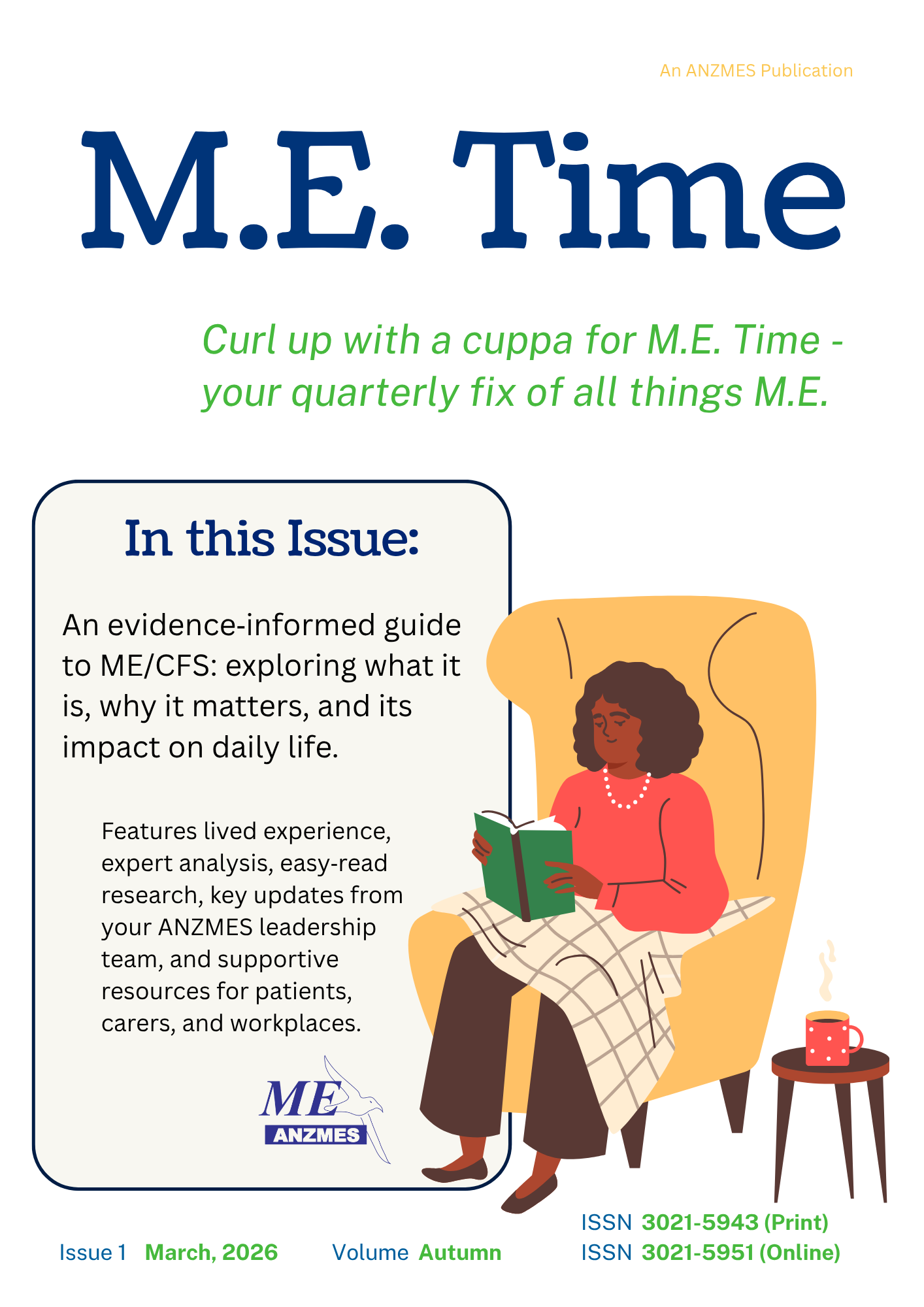
Press Release – ANZMES Launches M.E. Time — A Fresh, Evidence‑Informed Quarterly Magazine for the ME/CFS Community

March 2026 – ANZMES is proud to announce the launch of M.E. Time, our newly refreshed quarterly magazine designed to inform, empower, and connect people living with ME/CFS, Long COVID, and associated conditions across Aotearoa New Zealand.

Created fully in‑house for the first time, M.E. Time brings together evidence‑based research, lived experience, expert commentary, sector updates, and practical resources — all in a beautifully curated, easy‑to-read format. As President Fiona Charlton writes in her opening message:

“To gain control over the look, feel, and content, we are now producing the magazine in-house… Your feedback played a large part in the revitalisation of the magazine and we hope you will love it as much as we do!”

This refreshed publication replaces Meeting Place and marks a new chapter in how ANZMES communicates with and advocates for our community.

A Magazine for Everyone — Now Available to Non‑Members

For the first time, M.E. Time is available not only to ANZMES members but also to the wider public.

Members continue to receive the magazine free of charge, while non‑members can now purchase individual issues through our online shop.

This ensures the publication meets ISSN requirements for public availability — and allows anyone interested in ME/CFS, Long COVID, or post‑viral illness to access high‑quality, evidence‑informed content.

What’s Inside Issue 1

The inaugural issue is rich with content spanning research, advocacy, lived experience, and practical support. Highlights include:

✔ Expert Voices

Featuring insights from Dr Ros Vallings and Professor Warren Tate, who discuss the biological basis of ME/CFS and the overlap with Long COVID:

“There are clear signs of immune dysfunction, inflammation, and metabolic disturbances…”

✔ Lived Experience

Deeply personal stories from people navigating ME/CFS and Long COVID — including reflections on pacing, disability, and resilience.

✔ Research Digest

Easy‑read summaries of cutting‑edge biomedical research, including genetics, immune dysfunction, mitochondrial science, and post‑viral mechanisms.

✔ Advocacy Updates

A roundup of ANZMES’ recent submissions and policy work, including protecting carers, safeguarding youth on Job Seeker Support, and ensuring ME/CFS expertise is embedded in Long COVID care pathways.

✔ Community News & Spotlight

Sector collaborations, media coverage, and a feature on ME Respite’s practical support services.

✔ Resources & Events

Patient guides, carer resources, support group listings, and details for the 2026 Writing & Poetry Competition.

Why This Matters

M.E. Time is more than a magazine — it’s a platform for connection, education, and empowerment. It reflects ANZMES’ commitment to:

  • Evidence‑based information
  • Community voice
  • Sector leadership
  • Accessible, compassionate communication

Get Your Copy

  • Members: Your free digital copy is available now.
  • Non‑members: Purchase Issue 1 for $5.00 via the ANZMES online shop.

Whether you’re living with ME/CFS or Long COVID, supporting someone who is, or working in healthcare, M.E. Time offers a thoughtful, evidence‑informed companion for your journey.

Press Release – World ME Alliance Launches Medical Education Hub Featuring Key ANZMES Clinical Resources

For Immediate release – 28/10/2025

The Associated New Zealand ME Society (ANZMES) is proud to announce that its key clinical resources are featured on the new Medical Education Hub, launched in the last week by the World ME Alliance (WMEA). The WMEA is a global coalition of ME organisations working to improve understanding, diagnosis, and care for people with ME/CFS worldwide.

The hub is a dedicated online resource designed to equip healthcare professionals globally with essential knowledge about ME/CFS. This initial launch is a pilot version, which the WMEA plans to build upon and improve over time, particularly regarding accessibility and language options.

The hub provides a comprehensive library, featuring resources in multiple languages and organised by key categories for healthcare professionals. ANZMES is proud to have its vital resources for Primary Care in ME/CFS and long COVID and Secondary Care for Severe ME/CFS and long COVID featured alongside materials from other internationally renowned sources, including the Bateman Horne Center, CDC, Mayo Clinic, and NICE; setting a clear benchmark for evidence-based guidance.

Collectively, the guidelines and resources on the hub directly address critical gaps in medical education for both primary and secondary care settings. This empowers clinicians worldwide to provide better, more informed care for individuals living with ME/CFS and long COVID.

The Medical Education Hub is now live and accessible to the public and healthcare professionals. The WMEA is actively seeking user feedback to guide future developments.

View the new hub at: worldmealliance.org/medical-education-hub 

Press Release – Grant Scholarship Winners 2025

For Immediate release – 14/10/2025

ANZMES, Aotearoa’s National Advisory on Myalgic Encephalomyelitis/Chronic Fatigue Syndrome (ME/CFS), is proud to announce the two recipients of our 2025 Grants & Scholarships Programme. Marking the third consecutive year of this vital initiative, the programme continues its dedicated support for groundbreaking research into ME/CFS and the overlapping challenges of Long COVID within New Zealand. 

ANZMES is delighted to confirm that Dr. Natalia Boven of the COMPASS Research Centre at the University of Auckland has been awarded a $25,000 Grant as part of the 2025 funding round. This Grant will contribute towards the costs of her project, titled “Identifying child and adolescent predictors of adult ME/CFS and Long COVID,” which will use linked administrative data to explore the association between childhood health conditions – particularly those linked to dysfunctional mast cell activation (MCAS) – and the risk of developing ME/CFS and Long COVID in early adulthood. The research team at the University of Auckland includes Dr. Anna Brooks, Keith McLeod, Dr. Nick Bowden (a 2023 ANZMES grant recipient), Dr. Lisa Underwood, Dr. Nicola Gillies, and Dr. David Musson. This crucial study is intended to help reduce diagnostic delays, inform risk mitigation strategies, and contribute to understanding underlying pathophysiology.

Natalia Boven, the 2025 Grant recipient, states: “We are excited to have been awarded a research grant from ANZMES to allow us to pursue our research into ME/CFS and Long COVID.” We hope this research will help identify individuals at greater risk of developing ME/CFS and Long COVID, reduce diagnostic delays, and contribute to understanding of underlying pathophysiology. We are really grateful to ANZMES for funding this research.”

ANZMES is also pleased to announce Galina Mandich of the University of Otago as the recipient of a $10,000 research scholarship. The funding will support a 10-week summer research project, providing a $7,000 internship stipend and $3,000 for research materials and expenses. The study is titled: “Development of a genetic susceptibility test for developing Myalgic Encephalomyelitis/Chronic Fatigue Syndrome and Long COVID: Has the large 2025 Decode ME GWAS study provided a key advance?”.  The study, conducted alongside Emeritus Professor Warren Tate and Katie Peppercorn, will analyse blood samples in families where multiple members are impacted by ME/CFS and Long COVID. The aim is to identify common genetic markers or a ‘signature’ shared between them. This signature could be a significant step towards earlier diagnosis, treatment, and improved outcomes for those impacted by these debilitating conditions. 

Galina Mandich, the 2025 Scholarship recipient, states: “It can eventually provide healthcare practitioners with an important tool to support individuals with earlier intervention and care, alongside ongoing education to raise awareness and understanding. It is a privilege to continue learning about ME/CFS/LC, and I am very grateful to ANZMES for this wonderful opportunity. As a future clinician, it is my hope that this experience will provide invaluable knowledge for me to be able to provide clinical guidance and understanding towards patients with ME/CFS/LC and their families.”

Fiona Charlton, President concludes “We are pleased to offer substantial support for researchers dedicated to advancing our understanding of ME/CFS. This is only made possible by the support of our members so we’d like to give a special Thank You to them.” 

Press release – ANZMES publishes critical guide to help doctors navigate ME/CFS research and avoid harmful treatments

7th October 2025 – For immediate release

ANZMES, the leading National Advisory on Myalgic Encephalomyelitis/Chronic Fatigue Syndrome (ME/CFS), has published a new resource for healthcare professionals, “A Guide to Navigating Research: Discerning Robust vs. Flawed Science.” This essential article, released in conjunction with a one-page toolkit, is designed to combat a history of misinformation that has led to inadequate care and often harmful treatments for ME/CFS patients.

“Our goal is to arm doctors with the tools they need to critically evaluate health claims and research,” said Fiona Charlton, President of ANZMES. “By highlighting the difference between evidence-based medicine and flawed science, we can help prevent the cycle of misunderstanding and ensure patients receive care that is grounded in a true understanding of ME/CFS as a complex, biological disease.”

The new guide outlines key principles of quality research, including validity, reliability, and the crucial role of replication. It also provides a checklist for healthcare professionals to scrutinize a study’s source, methodology, and conclusions. The toolkit emphasises the importance of avoiding common research biases, such as confirmation bias and multiple testing bias, and advocates for the use of proper diagnostic criteria for ME/CFS research.

To help doctors quickly assess the quality of a study, ANZMES has identified key “red flags” and “green flags.”

Red flags of flawed science include studies with a conflict of interest (eg. funded by a for-profit entity), a lack of ethical oversight, or poor methodology such as the absence of a control group or a high drop-out rate. Research that relies on vague data, shows confirmation bias, and overstates conclusions not supported by the evidence should be viewed with skepticism.

Green flags of robust science signal a study that is transparent about its funding, has undergone a formal ethical review, and uses rigorous methodology, including the use of precise diagnostic criteria. Good research also integrates objective data, acknowledges its limitations, and is published in a peer-reviewed journal. The most trustworthy research is one whose findings have been replicated by independent research teams.

ANZMES urges healthcare professionals to embrace shared decision-making, where well-informed patients and their lived experiences are central to the treatment plan. This collaborative approach is vital for building trust and ensuring the management plan respects the unique needs of individuals with this historically misunderstood condition.

Access full article and one-page toolkit here:

Press Release – ANZMES Urges Rejection of the Regulatory Standards Bill: “A Threat to Public Health and Equity”

Release Date: 23rd June 2025

The Associated New Zealand Myalgic Encephalomyelitis Society (ANZMES) has lodged a formal submission opposing the Regulatory Standards Bill currently before the Finance and Expenditure Committee, warning that the legislation poses serious threats to public health, equity, and democratic governance.

While framed as a mechanism for improving legislation, ANZMES argues that the Bill prioritises corporate interests and economic efficiency at the expense of community wellbeing, Māori rights under Te Tiriti o Waitangi, and the government’s ability to protect its citizens.

“This Bill would codify neglect, lock in inequities, and diminish the government’s ability to act in the public interest,” said ANZMES President, Fiona Charlton.

Key concerns raised by ANZMES include:

  • Erosion of Public Health Protections: The Bill’s failure to include a public harm principle and its introduction of ‘takings’ provisions could deter life-saving regulations such as tobacco control, healthy housing, and pandemic preparedness.
  • Undermining Te Tiriti o Waitangi: The Bill promotes a narrow and universalist interpretation of “equality before the law” that disregards the Crown’s obligations to Māori. This risks dismantling targeted programmes essential for reducing health inequities.
  • Impact on the ME/CFS Community: With over 65,000 New Zealanders living with ME/CFS, ANZMES highlights how the Bill’s rigid economic framing would entrench the existing exclusion from disability supports, reduce funding for biomedical research, and block future policy progress.
  • Increased Bureaucratic Burden: For individuals with chronic illnesses like ME/CFS—many of whom experience cognitive and physical crashes following exertion—the Bill’s additional regulatory requirements would impose impossible barriers to engagement and justice.
  • Post-Viral Illness and Long COVID: With ME/CFS often triggered by viral infections, the Bill’s chilling effect on public health interventions could fuel a rise in disabling post-viral conditions and increase long-term health costs to the nation.

ANZMES calls for the complete rejection of the Regulatory Standards Bill, asserting that New Zealand needs compassionate, evidence-based regulation—not a framework that puts profits over people.

“This Bill won’t fix the system—it will freeze it in dysfunction,” said Charlton. “We need legislation that protects and uplifts our most vulnerable, not policies that entrench neglect.”

Ends.


For media inquiries, please contact, Angela Cayford:  

info@anzmes.org.nz | 03 471 6203

Press release – ANZMES Highlights Lessons from the COVID-19 Pandemic in Submission to Royal Commission

For immediate release – 24th April 2025

ANZMES Highlights Lessons from the COVID-19 Pandemic in Submission to Royal Commission

ANZMES (The Associated New Zealand Myalgic Encephalomyelitis Society) has made a detailed submission to the Royal Commission of Inquiry into COVID-19 Lessons Learned, underscoring the need for equitable and inclusive public health measures in future pandemic responses.

Drawing on over 40 years of expertise supporting individuals with ME/CFS, ANZMES’ submission reflects the unique experiences and challenges faced by vulnerable populations during the pandemic. It emphasises actionable lessons to strengthen public health planning, safeguard chronic illness communities, and foster trust in healthcare systems.

Key insights from the submission include:

  • Addressing systemic gaps in vaccine safety protocols, adverse reaction reporting, and mandates, with tailored guidance for vulnerable populations like those with ME/CFS and post viral conditions.
  • Reinforcing the importance of equitable lockdown measures, including flexible service delivery and targeted mental health support for vulnerable populations, including chronically ill individuals.
  • Promoting inclusive design of testing, tracing, and public health technologies to ensure accessibility for populations with cognitive impairments and limited mobility.
  • Advocating for ongoing support for post-viral illnesses through the establishment of a Centre of Excellence, fostering research, education, and patient-centered care.

“The COVID-19 pandemic revealed critical gaps in the recognition and support of individuals with chronic illnesses, like ME/CFS and long COVID,” said Fiona Charlton, President of ANZMES. “Our submission calls for proactive and inclusive strategies to ensure that these populations are no longer overlooked in future public health crises.”

ANZMES’s submission reflects a steadfast commitment to advocating for systemic reform and fostering collaboration with policymakers, healthcare providers, and communities to build a resilient and equitable healthcare system.

Ends.

Understanding ME/CFS and long COVID
Myalgic Encephalomyelitis/Chronic Fatigue Syndrome (ME/CFS) is a long-term, multi-systemic illness affecting the nervous, endocrine, autonomic, cardiovascular, and immune systems. It is often triggered by a viral illness and involves overwhelming fatigue and other symptoms that range in severity. Patients experience severe fatigue, post-exertional malaise (PEM), unrefreshing sleep, cognitive impairment, and orthostatic intolerance (to list a few). With over 100-200+ potential symptoms, the condition’s impact can vary greatly, making diagnosis and management highly individualised. Roughly 25% of all ME/CFS cases are categorised as mild, 50% as moderate-severe and 25% as very severe.

Long COVID (LC) is characterised by persistent, unexplained symptoms following infection with COVID-19 (SARS-CoV-2) lasting more than 12 weeks and not explained by an alternative diagnosis. Both conditions share symptoms such as extreme fatigue, cognitive dysfunction, and post-exertional symptom exacerbation (PESE), with up to 50% of long COVID cases fitting the diagnostic criteria for ME/CFS.

COVID developing to ME/CFS

Using data from a long COVID research initiative run by the US National Institutes of Health (NIH), the incidence of ME/CFS is now considered 15 times higher than pre-pandemic levels, and that people with a history of COVID are almost eight times as likely to develop the chronic condition. 

Post-Exertional Malaise (PEM) 

Post-Exertional Malaise (PEM), also referred to as post-exertional symptom exacerbation (PESE) in the context of long COVID, is a debilitating response to normal, every-day activities in people with ME/CFS. For individuals with severe-very severe ME/CFS or LC, this can be triggered by sensory overload, such as exposure to light or even simple conversations. Repeated episodes of PEM can exacerbate these already severe symptoms, and even minimal exertion can lead to significant setbacks for the patient’s health and wellbeing.

About ANZMES
The Associated New Zealand ME Society is the National Advisory on ME/CFS. Established in 1980, ANZMES has been at the forefront of research, representation, and education for ME/CFS in Aotearoa/New Zealand. The organisation’s expertise comes from its reputable medical team of advisors, which includes a world renowned expert and MNZM recipient, a fellow of the Royal NZ College of General Practitioners (RNZCGP) and a network of academic researchers, clinicians, and representatives from the ME community.

The organisation is a registered provider of continuing medical education with the Royal New Zealand College of General Practitioners (RNZCGP) and is dedicated to improving the lives of those affected by ME/CFS, long COVID, and associated conditions.

ANZMES is a founding member of the World ME Alliance, and a member of the Neurological Alliance NZ, long COVID Alliance, Carer’s Alliance, Disabled Person’s Assembly (DPA) and Access Matters.

The organisation’s vision is to live in a world where Myalgic Encephalomyelitis (ME)/ Chronic Fatigue Syndrome (CFS), long COVID (and associated conditions) are recognised, supported, diagnosed early, treated effectively, and cured.

The vision focuses the organisation’s mission as the trusted leader to fund and generate robust Aotearoa research, represent the global voice, and educate through best practice to improve outcomes.

The vision and mission drive the organisation’s purpose as the leading National Advisory to produce and deliver quality, reputable, authoritative, evidence-based information, data, research, and education. We represent the needs of the community to ensure best outcomes are the primary focus of healthcare, legislation, and services that affect people living with ME, long COVID, fibromyalgia, and dysautonomia.

PRESS RELEASE – ANZMES Calls for Equitable Tax Policies to Sustain Charitable Impact

ANZMES (The Associated New Zealand Myalgic Encephalomyelitis Society) has submitted a detailed response to the government’s consultation on tax exemptions for charities and not-for-profits (NFPs), urging them to support rather than hinder charitable efforts across Aotearoa/New Zealand. The submission highlights the urgent need to preserve critical tax relief measures for charitable organisations, ensuring that they can continue delivering essential services to vulnerable communities.

The response warns that taxing income from mission-aligned business activities, such as online stores or op shops, would jeopardise the financial sustainability of smaller charities. It could also reduce their ability to fund advocacy, education, and research initiatives for underrepresented conditions like ME/CFS.

“ANZMES exists to bridge gaps in understanding, support, and research for ME/CFS,” said Fiona Charlton, President. “We rely on innovative, mission-aligned funding solutions to fulfil our purpose. Taxing these efforts would divert resources away from the people who need them most.”

Key Points from ANZMES’ Submission:

1. Mission-Driven Income Should Remain Exempt:

   – Income from mission-aligned activities directly supports the organisation’s advocacy, education, and patient resources. Taxing this income would erode the charity’s capacity to deliver its mission.

2. Public Trust and Donor Confidence:

   – Taxing revenue risks undermining public trust in charities and donor intentions. Restricted funds like the Kathy Foley Trust, which supports diagnostic and emergency patient needs, exemplify the necessity of preserving exemptions.

3. Volunteer Contribution Recognition:

   – ANZMES depends on over 2,500 volunteer hours annually to provide cost-effective services. Imposing additional taxes on its income undervalues this societal contribution.

4. Equitable Tax Thresholds:

   – Current thresholds for charity business income exemptions, such as the $1,000 deduction, are outdated. ANZMES advocates for a higher exemption threshold to reflect the realities of small charities’ operations.

“We are committed to ensuring that New Zealand’s tax system reflects the values of fairness, inclusivity, and support for the community,” added Charlton. “Maintaining tax exemptions for mission-driven income is essential for the survival and growth of organisations like ANZMES, which play a vital role in addressing gaps in government and private sector support.”

ANZMES invites policymakers and the public to engage in meaningful dialogue to ensure that tax policies support, rather than hinder, charitable efforts across Aotearoa.

Ends.

Malcare WordPress Security