Associated New Zealand Myalgic Encephalomyelitis Society (ANZMES) is calling for ME/CFS to be reclassified as a disability.
We urge you to to pledge your support for this change.
People with this debilitating condition face a barrier to support under the current classification of “chronic illness” and as a result experience poor quality of life and health inequity. With increasing numbers of people with Long COVID (LC) being diagnosed with ME/CFS the existing support through nonprofit organisations is set to become unmanageable, with case numbers still rising.
With the new Whaikaha – Ministry of Disabled People still in development ANZMES sees that this is a timely opportunity to move forward with this long overdue change.
ANZMES President, Fiona Charlton says, “it is vital for ME/CFS and LC that this access is improved. “Many people have symptoms that are so severe that they struggle with daily tasks like showering, making a meal and are bedbound or require a wheelchair. “This growing community of chronically ill people deserve better treatment and urgently need more access to financial support and health services with acknowledgment that their illness is disabling.”
Photo Credit: Martyna Reynolds
Photo Credit: 123rf
Despite the symptoms of ME/CFS meeting many of the definitions for disability, the illness is not categorised as a disability in New Zealand for the purpose of health-related funding and support.
The Human Rights Act 1993 states that disability can be defined as:
Physical disability or impairment: physical illness: psychiatric illness: intellectual or psychological disability or impairment: any other loss or abnormality of psychological, physiological: or anatomical structure or function: reliance on a guide dog, wheelchair, or other remedial means: the presence in the body of organisms capable of causing illness.
Reclassification will lead to real improvements in quality of life for those in need. Some people with ME/CFS become ill and never return to their pre-illness capabilities – this makes the condition life-long. ME/CFS patients require home help, housing support, financial support, and counselling access. Many people, following COVID-19 infection, are being diagnosed with ME/CFS and also require ongoing support services.
Photo Credit: FitnessForThisAbility.com
Photo Credit: Glide.com.au
Reclassification of ME/CFS to disability would result in:
legitimisation and validation of a person living with ME/CFS as a disabled person, and a protection of their rights as a disabled person,
easier access to governmental financial support and ministry services,
increased access to social services,
access to need assessments as a recognised disabled person,
access to home-help support and services, including mobility aids, and grants for home modifications for wheelchair use,
access to free immunisations on a voluntary basis,
increased level of care and support through social services and educational institutions.
What is ME/CFS? A chronic illness involving overwhelming ongoing fatigue, ME/CFS is often triggered by a viral illness. The condition causes a variety of symptoms that range in severity as it affects many body systems, such as the immune, neuroendocrine and autonomic nervous system.
Who are ANZMES? ANZMES has been providing information, building awareness, funding research, and advocating for people with ME/CFS for the past 42 years (since 1980). As the national advisory body for ME/CFS in New Zealand, ANZMES disseminates evidence-based information nationally, and represents the ME/CFS voice globally as a founding member of the World ME Alliance. ANZMES acts as the voice of all people living with this disabling disease through advocacy and leadership.
The Associated New Zealand Myalgic Encephalomyelitis Society (ANZMES) supports the new position paper on the Lightning Process by the World ME Alliance and does not endorse the Lightning Process for Myalgic Encephalomyelitis/Chronic Fatigue Syndrome (ME/CFS).
The Lightning Process is a programme loosely based on concepts of neuro linguistic programming (NLP) and cognitive behaviour therapy (CBT) that is set up commercially and currently marketed as a cure for ME/CFS. This claim is not backed by scientific evidence and ANZMES shares the view of the World ME Alliance that the promotion of this programme is likely to do harm.
The National Institute for Health and Care Excellence (NICE), in the UK, revised their guidelines for the diagnosis, treatment, and management of ME/CFS stating that the lightning process should not be used as a treatment and they no longer recommend CBT. These changes reflect a shift from an outdated perspective that ME/CFS was a psychological condition and follows evidence from over 200 studies showing poor efficacy for this treatment approach.
ANZMES President, Fiona Charlton says, “there is a growing body of evidence that shows that ME is driven by physiological changes not psychological ones and telling people that they can talk themselves out of this condition, within three days, could be very harmful.
“We know that if people with ME ignore their symptoms and push themselves this can make things worse, sometimes to the point of needing hospital care.”
ANZMES agrees with the World ME Alliance who highlight in their statement that people with ME/CFS are vulnerable to exploitation due to a lack of effective treatment where programmes like the Lightning Process are just filling this void.
People living with Long COVID are also being drawn into this treatment as this is now an extension of their claims to cure ME/CFS.
Other concerns with the Lightning Process include a bias in efficacy studies, including conflicts of interest, a reported secrecy where participants are told not to speak about the programme or their symptoms and a level of shame and guilt for those who do not recover within the three days of treatment.
Charlton says, “we want to ensure that if we are endorsing a treatment for ME that robust evidence supports efficacy and this is just not the case with LP.
“What we do know is that a treatment approach that is focussed around symptom management is shown to help with the relapsing nature of ME.”
ANZMES acknowledges that neurological symptoms, such as depression and anxiety can be a part of ME/CFS and may benefit from supportive therapies but people have the right to unbiased, impartial information when being offered these treatments.
***********************
The Lightning Process was developed and trademarked by British osteopath and hypnotherapist Phil Parker.
ANZMES has been providing information, building awareness, funding research, and advocating for people with ME/CFS for the past 42 years (since 1980). As the national advisory body for ME/CFS in New Zealand, ANZMES disseminates evidence-based information nationally, and represents the ME/CFS voice, globally as a founding member of the World ME Alliance. ANZMES acts as the voice of all people living with this disabling disease through advocacy and leadership.
The World ME Alliance, a collaborative of organisations from across the globe, is launching World ME Day on 12th May this year. This new initiative aims to bring together organisations and unify efforts to raise awareness and campaign together on Myalgic Encephalomyelitis (ME). Through collective action, we will step closer to our goal of a world without ME.
World ME Day will build on the incredible efforts of advocates around events, such as ME Awareness Week and Chronic Immunological and Neurological Diseases (CIND) Awareness Day. By focusing on a single day and collaborating across many organisations, we aim to maximise our collective power.
The theme for the first year of World ME Day is #LearnFromME.
ME is a global health crisis – up to 30 million people are living with this disease worldwide, and when we take into account the effect on families, carers and friends too, the impact of this disease cannot be overstated.
But there is much to be learnt from this disease – from the willpower and determination of those living with it, to the incredible advocates working towards change, to an understanding that the most meaningful change will comes from high-quality research.
We want to use World ME Day to reach out to health professionals on a personal basis, build understanding of ME and take another step towards a world that understands ME.
Key facts for health professionals
People with ME have a lower average quality of life than all other diseases they have been compared to, including diabetes, cancers and heart disease.
At the request of the ME/CFS community, ANZMES has issued a survey relating to reactions experienced by the community to the COVID-19 Pfizer BioNTech vaccine. ANZMES also sought to ascertain prevalence of Long COVID and COVID-19 infection in the community. The opportunity was also utilised for respondents to express interest in participating in a potential fractionated dosing trial.
This report contains preliminary findings for responses received from 21st October 2021 to 10th November 2021. This survey is still open to capture experiences after these dates, as vaccination decisions are ongoing.
Please note that this survey is classed as a self-report questionnaire which seeks to ascertain the subjective experience of people with ME/CFS and co-morbid conditions. The information collected is therefore anecdotal data. No clinical research has been conducted.
Respondents
395 respondents identify with an ME/CFS diagnosis
144 with Fibromyalgia (some overlap with ME/CFS)
19 with COVID-19
5 diagnosed with, and 32 suspect, Long COVID
The majority of respondents have a clinical diagnosis of ME, with 25 self-diagnosed. Most are unsure as to which diagnostic criteria for ME was used.
Some questions have less respondents, therefore numbers are indicated in the relevant sections.
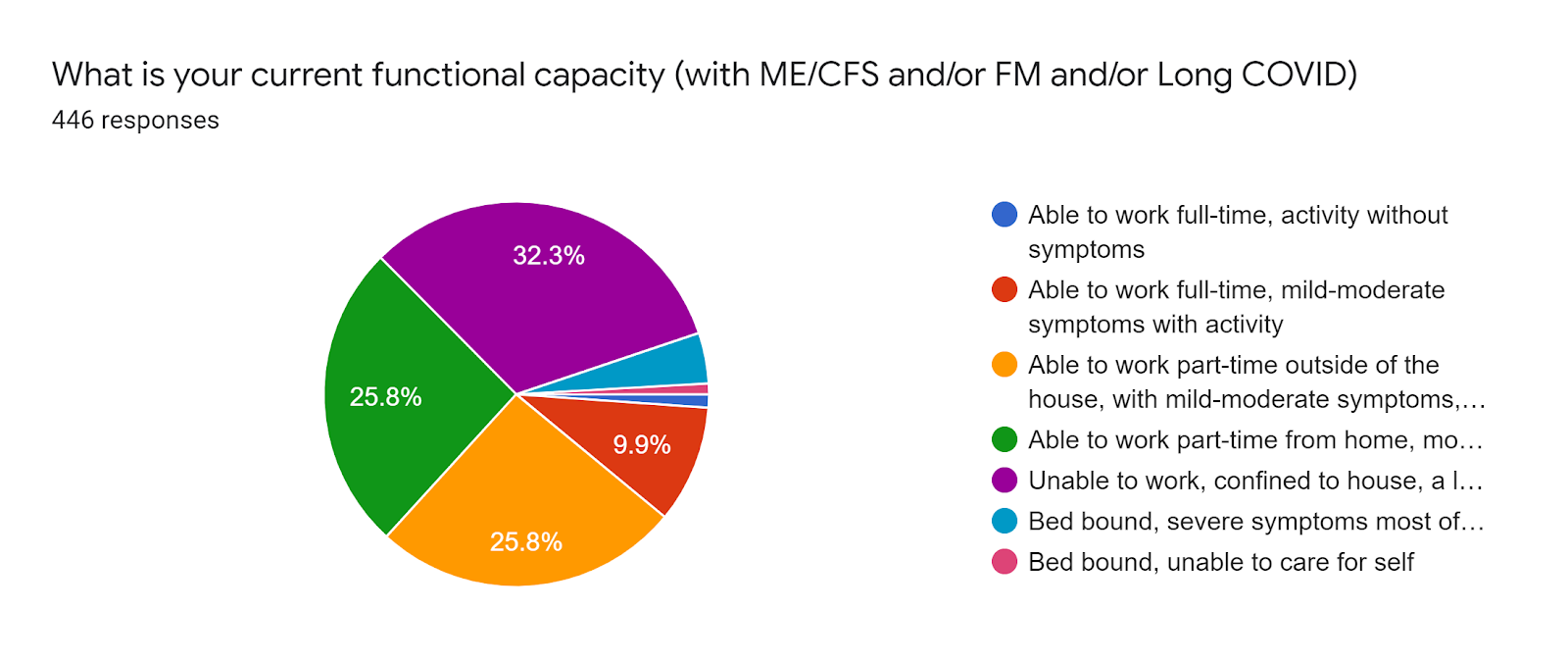
Functional capacity (pre-vaccination)
32.3% (144 individuals) are unable to work, confined to their home with a lot of rest required.
25.8% (115) are able to work part-time at home.
25.5* (115) are able to work part-time outside of the house.
9.9% (44) are able to work full-time with mild-moderate symptoms with activity. 1.1% (5) are able to work full-time without symptoms. * These respondents were mostly COVID-19 infection or Long COVID respondents without ME/CFS.
4.3% (19) are bedbound most of the time.
0.9% (4) are bedbound and unable to care for themselves.
Vaccination rates
The majority of respondents have had two doses of the Pfizer vaccination.
64.5% (296) two doses.
16.1& (74) single dose.
19.2% (88) have not been vaccinated.
Of the 296 with two doses, the duration between doses was 6 weeks or more for 166 individuals and 3 weeks for 130.
Pattern for capacity and reaction
These findings suggest that the more disabling the ME/CFS symptoms, the more prone to a relapse after vaccination but that relapse can occur at any functional capacity state for pwME. This was analysed when there were 241 responses.
Temporarily worsened
Improved
No change
Worsened into relapse
Worsened beyond illness
Not vaccinated
No answer
Part-time work home
22
8
7
9
1
14
2
Part-time outside house
22
3
17
14
0
12
2
Full-time work mild-mod with activity ME FM Long COVID/COVID
3 2 0
0 0 2
4 1 3
3 1 0
0 0 0
2 0 1
2 0 5
Unable to work, confined to house
23
6 3 temp
15
18
7
8
7
Bedbound mostly
2
0
0
3
0
1
1
Bedbound unable to care for self
0
0
0
1
0
1
1
Overall ME
72
20
43
48
8
30
20
First dose vaccination reaction and duration
There were 39 individuals who did not experience any symptoms. For those who did experience reactions to the first dose of the vaccine, these were consistent with the expected normal immune response, e.g.:
sore at injection site (300)
tired/fatigued (219)
Headache (142)
nausea/gastrointestinal issues (62)
fever/chills (56)
Swollen lymph nodes (46)
Sleep issues/insomnia (44)
5 people experienced heart palpitations and/or anxiety 3 people experienced skin sensitivity and/or allergy flares, with 2 people experiencing brain fog/cognitive issues.
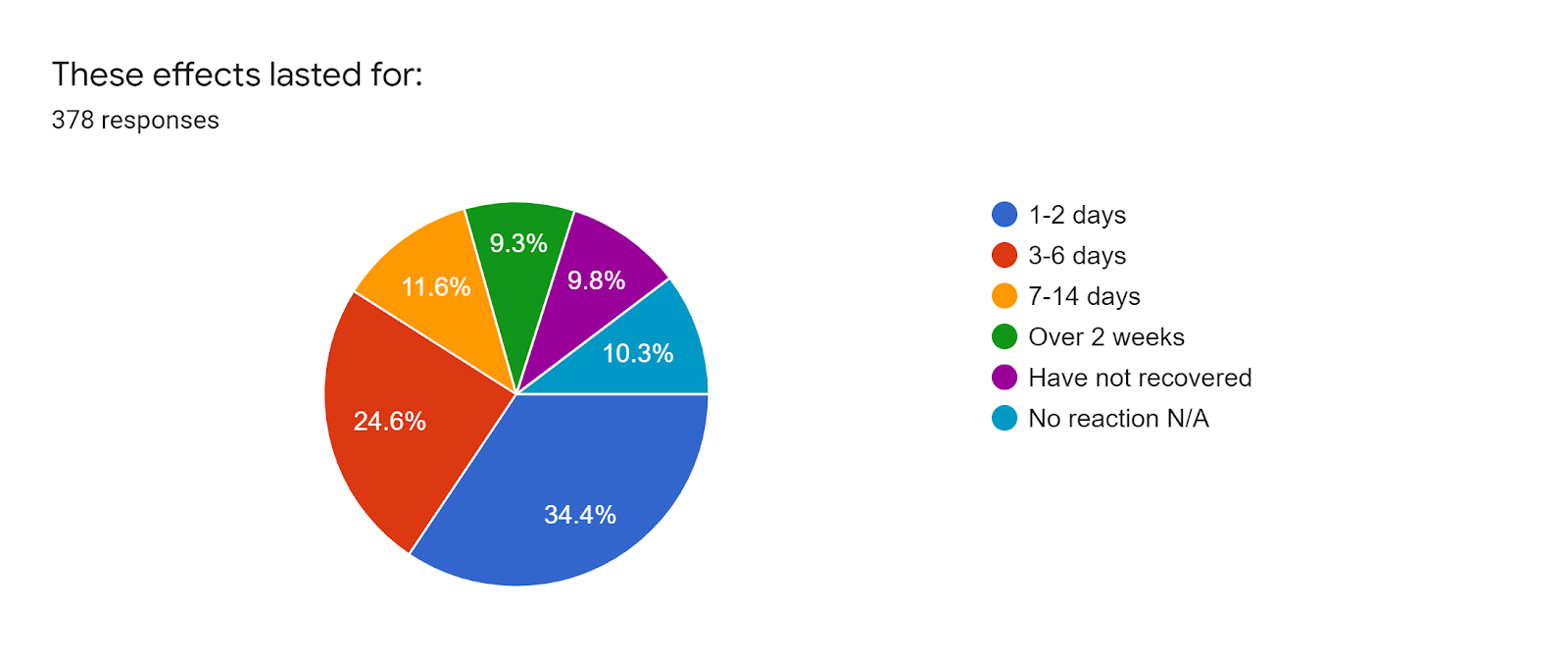
For most people (130) these symptoms lasted 1-2 days.
For 93 individuals it lasted 3-6 days.
44 experienced symptoms for 7-14 days.
35 for over 2 weeks.
37 have not recovered.
Second dose reaction and duration
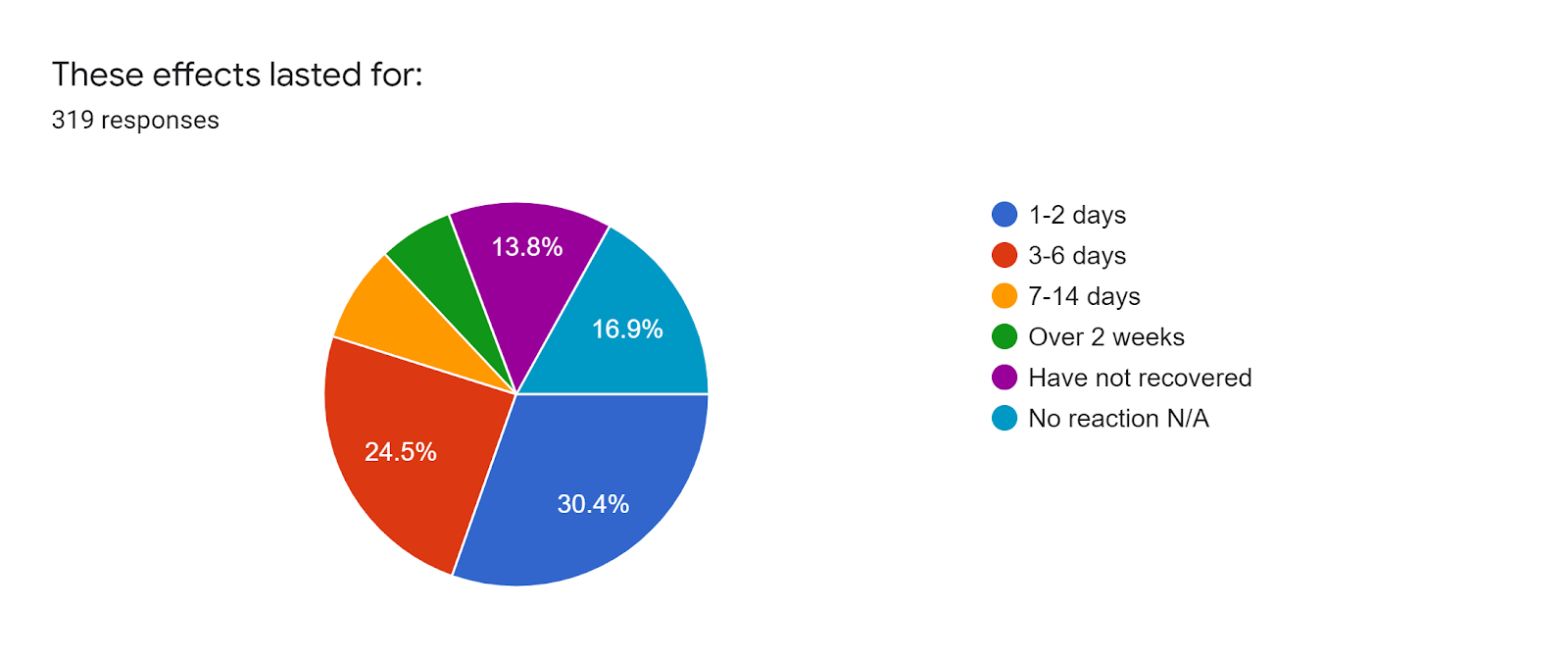
As has been reported by the general public, the findings from this survey suggest that pwME also experienced more adverse reactions to the second dose of the Pfizer vaccine. However there were 54 individuals who did not experience any symptoms.
For 97 individuals these symptoms lasted 1-2 days.
For 78 individuals it lasted 3-6 days.
26 experienced symptoms for 7-14 days.
20 for over 2 weeks.
44 have not recovered.
Vaccine effect on state of illness/wellness for 359 respondents
137 (38.1%) experienced no change/stay the same
118 (32.9%) temporarily worsened but have returned to baseline
71 (19.8%) worsened and not returned to baseline – relapsed
22 (6.1%) improved
11 (3.1%) worsened beyond anything experienced in illness to date – severe relapse
289 respondents did not have any new symptoms that they could attribute to the vaccine.
52 stated that they had new symptoms that they could attribute to the vaccine. These symptoms tended to be over-activation of the immune response, e.g. sore throat, swollen neck glands, allergy reactions. Of these 52 – 4 individuals have gastrointestinal issues, 2 experienced more fatigue whilst 1 indicated improved energy.
Clinical care
From 383 responses 314 (82%) were not offered clinical care during vaccination, 15 (3.9%) were offered clinical care, 19 (5%) were unsure. 25 people asked for specific clinical care during the vaccination process. Of those offered clinical care the options were 30 minute observation rather than the normal 15, separate areas with direct nurse observation. Others were advised by their GPs to rest and take antihistamines pre- and post-vaccination.
Caregiving requirements
From 353 respondents 50 require ongoing caregiving for their ME/CFS and/or FM and 70 required care after vaccination. 244 people do not require caregiving before and 230 after.
Fractionated dosing interest
If fractionated / lower dosing had been an option, of 115 responses 48 stated they would have considered it, 23 said they would not consider it and 44 were unsure.
Of 88 responses for those reluctant to have the vaccine, 57 would consider lower dosing options, 10 would not, and 21 were unsure.
Of 124 responses to indicate interest in participation in a potential trial into fractionated dosing, 61 responded that they are interested, 31 may be interested, and 32 are not.
Antihistamine usage
Of 115 responses 45 did not take any pre- or post-vaccination, 70 did.
Reasons for not being vaccinated
Of 1Anxiety/worry/fear about potential adverse reactions, previous adverse reactions to other vaccines, concern about the safety of the vaccine, high ME/CFS symptomatology, chemical sensitivities/MCS/MCAS, not currently well enough to risk adverse reactions.
COVID-19 / Long COVID
19 respondents have been diagnosed with SARS-CoV-2 (COVID-19) infection.
169 respondents have had COVID-19 tests.
5 people have been diagnosed by a medical professional with Long COVID.
32 people suspected they have Long COVID after a viral infection due to ongoing or lingering classic COVID-19 symptoms and having been connected to a location of interest, an overseas hot zone of infection, or have remained unwell after experiencing a viral infection that has not been confirmed as COVID but has the same symptoms.
Debbie, ANZMES manager with resources ready to give out.
Doctor Ros Vallings lectured at the Colquhoun Theater in Dunedin on the 22nd September, 2014 to make a Podcast for Medical Students education at a public meeting.
Resources were given to Doctors and Medical Students who attended plus members of the public. There were over a large crowd who turned up on a cold snowy day to listen to the latest information from Ros.