ANZMES 2023 AGM Report

The ANZMES AGM was held at 1pm on the 18th November 2023 via ZOOM online meeting.

This was ANZMES 43rd AGM of caring and supporting people with ME/CFS and their whanau and carers, as well as disseminating information, resources, and education to them, the general public, and medical professionals. ANZMES is looking at new initiatives as part of our strategic planning for the next year, and will continue to fund vital research that benefits the ME/CFS community as more physiological evidence is discovered and more understanding of the condition is brought to the fore.

Fiona Charlton (President) opened the AGM Meeting and the President’s report outlined some of ANZMES activities throughout the year. 

Highlights included;

  • This year we are proud to have launched a Grant and Scholarship Programme for postgraduate students and academic researchers. This will be an annual fund for ME/CFS and long COVID study. Two exciting projects are proceeding thanks to the ANZMES Grants of $25,000 each
  • ANZMES launched Know M.E. Series for health professionals providing a monthly newsletter packed full of evidence-based information and research. The associated video podcasts are publicly available. This series is CME accredited by the Royal NZ College of GP’s, and ANZMES is a Registered Provider for continuing medical education. This series features a newsletter covering a different topic each month. Know M.E. also includes a podcast which is publicly available on Spotify, iHeart Radio, Google Podcasts, and iTunes/Apple. The video version is publicly available on YouTube. Each month features special guest interviews speaking about M.E. topics.
  • In May 2023 ANZMES launched two one-page resources for the diagnosis and management of ME/CFS and long COVID in primary care.
  • In early November 2022 we held a long COVID educational event for health professionals. We had over 150 registrants, including GPs, nurses, nurse practitioners, clinic managers, med students, physiotherapists, OTs, and more. Our speakers talked about post exertional malaise and how to avoid it, described the similarities and differences between Long COVID and ME/CFS, how to diagnose both conditions, how to treat through allied health, and the effects of COVID and Long COVID in Māori and Pasifika communities.
  • Dr Sarah Dalziel attending the the 3rd ME/CFS International Conference 2023: RID – Research Innovation and Discovery and provided a summary of the conference.

All present committee member’s have continued their term and were voted on for the upcoming year. The appointments are as follows:

President – Fiona Charlton

Vice President – Ange Robinson

Treasurer – Amy Ma

Reviewer – Alan Shanks

Executive committee – Anna Brooks, Suzanne Duffy, Wendy Matthews, Steve Murray, Gabby Shortt and Ros Vallings.

Heather Wilson who has been on the ANZMES committee for well over 20 years has now stepped down. A very, very special thanks go to Heather for her hard work and time spent on the committee and time spent helping people and their whanau, it is much appreciated. After the AGM was announced closed a presentation was played of Heather’s farewell which was held online and in person in Dunedin on Friday 3rd November 2023.

Dr Sarah Dalziel and Ken Jolly both continue as ex officio Medical Advisor’s to ANZMES. We would like to sincerely thank Sarah and Ken for their time and effort to help answer any queries we may have in the medical field. 

Membership Fees for 2024 have remained unchanged, they are set at:

  • $10.00 for Full membership
  • $5.00 for Concessionary membership
  • $5.00 for Family members
  • A free Helping Hand option will be available for people who suffer severe financial hardship.

After the AGM had finished, Dr Sarah Dalziel gave a presentation on her attendance at the 3rd ME/CFS International Conference 2023: RID – Research Innovation and Discovery. 

YouTube links to the AGM attached below
AGM 2023 – 1 of 3
AGM 2023 – 2 of 3
AGM 2033 – 3 of 3

Press Release – ANZMES welcomes HSC recommendations for improved access to disability services for people with ME/CFS.

For immediate release – 22/08/2023

Petition response: ANZMES welcomes Committee recommendations for improved access to disability services for people with ME/CFS

ANZMES, the National Advisory on Myalgic Encephalomyelitis (ME), has welcomed the Health Select Committee’s (HSC) response to its petition delivered in September 2022, calling on the Government to reclassify ME as a disability.

The Health Select Committee presented its report to parliament on 17th August 2023, sending a strong message acknowledging ANZMES petition to reclassify ME – also known as Chronic Fatigue Syndrome (CFS) – as a disability with the recommendation that eligibility criteria for disability services be amended.

The 10 page HSC Report recommends that the Government take note stating “we understand that ME/CFS meets the Government’s definition of a disability. We therefore, encourage Whaikaha to consider amending its eligibility criteria to enable people with ME/CFS to access Whaikaha-funded disability support services.”

The Report also acknowledged concerns raised by ANZMES that the current classification and system is flawed with complicated assessment processes and policies and disparity between regions causing access inequality.

ANZMES President Fiona Charlton says the acknowledgement and recommendations are “a step in the right direction.”

“The struggle is real for so many people with ME and improving access to Whaikaha-funded support services could give so much relief to them.”

The HSC Report acknowledged that the eligibility criteria differ between Whaikaha and Te Whatu Ora-funded services, resulting in inequitable access.

The Report also states that a person does not require a classified disability to access health services, however in practice ANZMES has found that many with ME/CFS are denied help, despite the obvious need. ANZMES understand that support needs to be prioritised but at present, due to a misconception around the severity of the illness and the lack of functionality that results, many are seen as low on the priority scale.

ANZMES plans to continue to discuss this with the government and Whaikaha and would like them to consider working together to improve current assessment pathways and streamline the process to reduce access inequity across the country.

People with this debilitating condition face a barrier to support under the current classification of “chronic illness” and as a result experience poor quality of life and health inequity. With increasing numbers of people with long COVID (LC) being diagnosed with ME/CFS the existing support through nonprofit organisations is set to become unmanageable, with case numbers still rising.

People with ME want to see the actual implementation of these recommendations. Practical help is urgently needed for this growing under-supported, disabled community that could lead to a better prognosis and better quality of life.

To view the full report:

——————————————————————————–

What is ME/CFS?

Myalgic Encephalomyelitis/Chronic Fatigue Syndrome (ME/CFS) is often triggered by a viral illness and involves overwhelming fatigue and other symptoms that range in severity as it affects many body systems, such as the immune, neuroendocrine and autonomic nervous system.

The key characteristic of ME/CFS is post exertional malaise (PEM) which presents 12-48 hours after exertion, and can result in days to weeks of exacerbated symptoms. For the very severe, this exertion can be simply trying to speak, or eat.

ME ANZMES logo with albatross bird representing support

Who are ANZMES?

The Associated New Zealand ME Society (ANZMES) has been providing information, awareness for ME, funding research, and advocating for people with ME for the past 43 years (since 1980). As the National Advisory on ME in Aotearoa/New Zealand, ANZMES disseminates evidence-based information nationally, and represents the ME voice globally as a founding member of the World ME Alliance. ANZMES acts as the voice of all people living with this disabling disease through advocacy and leadership. ANZMES is a RNZCGP registered provider for continuing education. Health professionals can earn CME/CPD credits with ANZMES latest education programme – Know M.E. – a video podcast and news series featuring up-to-date, evidence based research and information on ME/CFS and Post COVID Conditions.

————————————————————————————-

For more information contact

info@anzmes.org.nz

BenefitME

CivicTheme demo logo

BenefitMe is a new website aimed at helping people find what benefits they can receive.

There are lots of Work and Income benefits for people who need help in Aotearoa New Zealand, but it can be hard to know which ones you can get. BenefitMe helps you find out what you’re eligible for and what happens if things in your life change.

BenefitMe is a community effort to put some power back into the hands of the public, so anyone can find the support and services they’re legally eligible for and be more able to engage from a position of confidence with government departments.

Payments currently supported:                                     

  • JobSeeker    
  • Sole Parent Support                                       
  • Disability Allowance
  • Accommodation Supplement 
  • Emergency Benefit (see Discretionary benefits)

BenefitMe is an initiative by the Digital Aotearoa Collective (DAC), a civil society group committed to addressing injustice and improving wellbeing in Aotearoa New Zealand. Click the link to find more about BenefitMe

ANZMES speaks on RNZ about reclassification

ANZMES President, Fiona Charlton spoke alongside Emeritus Professor Warren Tate from the University of Otago, and patient advocate Tom Harris to Kathryn Ryan on Nine to Noon on Radio New Zealand this morning.


You can view the Radio New Zealand interview news bulletin here: https://www.rnz.co.nz/national/programmes/ninetonoon/audio/2018892129/the-fight-to-get-me-chronic-fatigue-syndrome-classified

You can listen to the interview episode here:
https://www.rnz.co.nz/audio/player?audio_id=2018892129


The petition to reclassify Myalgic Encephalomyelitis to a disability is currently with the Health Select Committee, who are due to provide their recommendations to parliament in the coming months. This follows an oral submission to them by ANZMES on May 3rd 2023, a written submission presented in October 2022, and the petition with 6,444 signatures, submitted to parliament in September 2022.

ANZMES created this petition to draw attention to the fact that the system is not working for people with ME/CFS (pwME). Many fall through the cracks, many rely on whānau to care for them. Those who aren’t lucky enough to have family to care for them, experience post exertional malaise crashes regularly just trying to make a meal or do laundry. This means they’re in a constant state of unwellness with a myriad of over 100 symptoms. You can learn more about post exertional malaise on ANZMES World ME Day page.

Put simply:

ME/CFS fits the definition for disability
BUT
DOES NOT fit the criteria to access disability support services.

Those same support services are available under Long Term Support – Chronic Health Conditions
BUT
People with ME/CFS DO NOT fit the NASC* criteria to access them.

The system is not working for people with ME/CFS.

*NASC – Needs Assessment Service Coordination.

ME/CFS fits all definitions for disability created by the United Nations, The World Health Organisation, The Human Rights Act 1993, Statistics NZ, and the NZ government’s own definition (copied below).
A disability is an impairment — physical, intellectual or sensory — that lasts
for more than 6 months and limits your ability to carry out day-to-day activities.

pwME experience physical, cognitive, and sensory impairments.
The condition for most, is chronic, for some it is lifelong.
To be diagnosed with ME/CFS, one must experience at least a 50% reduction in ability to function (compared with pre-illness capacity).

ME/CFS fits the definition of disability. ME/CFS is a disability.

What would it mean to reclassify?
A change in classification would be a lifeline to dedicated support and wider acknowledgement that this illness is disabling, providing fairer access to established support and care.

Being classified as a disability demonstrates the government understands how truly disabling this condition is.
It legitimises ME/CFS as a physiological disease, which would foster the standardising of healthcare for pwME. Legitimising ME/CFS as the disability it is, should override and negate outdated opinions and treatments. It would provide pwME protection of rights as a disabled person.

It would ensure the government upholds its legal obligation to adhere to the United Nations (UNCRPD) Report (September 2022) which states that ME/CFS should be included in disability policies and supported by disability services.

It will enable pwME to fit into the criteria for NASC assessment for home help services. Access to services equates to intervention that promotes recovery or at the very least improvement in symptom management. When a person is constantly exerting beyond their energy capabilities, they crash. This is a health issue. NASC assessments are not conducted by the Ministry of Social Development, they are conducted through hospitals and the healthcare system. It is a healthcare issue.

ANZMES President, Fiona Charlton states “Members of Parliament are elected by the people, for the people. It is a democratic government’s role to ensure all policies, procedures, and programmes meet the needs of all New Zealanders. People with ME/CFS are New Zealanders. Yet, their needs are not being met. There is no-one in parliament representing us. We have to advocate for ourselves, yet who is listening? Who in parliament will stand up for and advocate for the needs of pwME? Who will ensure our needs are met?”

In 2012, following a petition by ANZMES Executive Committee member, Wendy Matthews, the then Health Select Committee made the recommendation to reclassify ME/CFS as a disability.

This was NOT implemented by government.

Fiona Charlton states “We have hope that the Health Select Committee will once again make the recommendation to reclassify ME/CFS as a disability.
However this time, we also urge these committee members to use their roles within parliament to ensure the government implements the advice.”

ANZMES invite members of parliament to speak with them. ANZMES has the knowledge, expertise, and lived experience. ANZMES has world-renowned clinicians on the executive committee and medical team, and researchers like Emeritus Professor Warren Tate are available for discussions.

ANZMES current Royal NZ College of General Practitioners (RNZCGP) CME (continuing medical education) accredited series: Know M.E. is freely available to all health professionals seeking to understand the biomedical, physiological nature of ME/CFS and evidence-based management strategies.

The information is available for a considered, evidence-based response from parliament to meet the needs of people with ME/CFS. ANZMES offers solutions in its written submission (October 2022), and written report submitted to Health and Disability Ministers and Commissioners in July 2022. You can view the oral submission here: anzmes-speaks-to-parliament.

ANZMES looks forward to the recommendations from the Health Select Committee in the coming months.

ANZMES is dedicated to continually advocating, supporting, educating, and funding research for pwME.


Who are ANZMES?
The Associated New Zealand Society for ME/CFS (ANZMES) have been providing information, awareness for ME/CFS, funding research, and advocating for people with ME/CFS for the past 43 years (since 1980). As the national advisory body for ME/CFS in New Zealand, ANZMES disseminates evidence-based information nationally, and represents the ME/CFS voice globally as a founding member of the World ME Alliance. ANZMES acts as the voice of all people living with this disabling disease through advocacy and leadership. ANZMES is a RNZCGP registered provider for continuing education. Health professionals can earn CME/CPD credits with ANZMES latest education programme – Know M.E. – a video podcast and news series featuring up-to-date, evidence based research and information on ME/CFS and Post COVID Conditions.

ME/CFS Reclassification Petition – ANZMES set to speak to parliament

ANZMES is set to speak to parliament on May 3rd to present an oral submission to the Health Committee – an opportunity to strengthen the argument for the reclassification of ME/CFS to a disability.

Associated New Zealand Myalgic Encephalomyelitis Society (ANZMES) petition to reclassify ME/CFS as a disability was read in Parliament, on the 13th of September 2022, and has been under consideration with the Health Committee since then.

ANZMES president, Fiona Charlton, will speak to parliament on behalf of the members that she represents, along with Emeritus Professor Warren Tate and RCNZGPs Fellow Dr. Sarah Dalziel, who will answer the committee’s questions.

ME/CFS is a debilitating long term condition that affects multiple body systems and is characterised by Post Exertional Malaise, where symptoms worsen after periods of even ordinary activities. The current classification of ME/CFS as an illness rather than a disability makes it difficult for individuals who suffer from the condition to access the necessary support that they need to lead quality lives.

“We must make this chronic condition a disability now and give people fair access to the help that they need,” says Charlton.

A growing number of people with long COVID are now being diagnosed with ME/CFS, putting strain on already exhausted resources.

There is no dedicated funding for the condition and the current classification and system is difficult to navigate. There are complicated assessment processes and policies. There is disparity between regions causing access inequality.

In order to be diagnosed with ME/CFS a person must be significantly impaired in terms of functioning in daily life, such as work or school.

ANZMES has presented the government with detailed reports, research and recommendations and now hope that they will listen and take the urgent action that is needed.

Reclassification will lead to real improvements for those in need; providing access to disability support services – much needed home help, housing support, financial support, and counselling access.


What is ME/CFS?

Myalgic Encephalomyelitis/Chronic Fatigue Syndrome (ME/CFS) is often triggered by a viral illness and involves overwhelming fatigue and other symptoms that range in severity as it affects many body systems, such as the immune, neuroendocrine and autonomic nervous system.

The key characteristic of ME/CFS is post exertional malaise (PEM) which presents 12-48 hours after exertion, and can result in days to weeks of exacerbated symptoms. For the very severe, this exertion can be simply trying to speak, or eat.

Who are ANZMES?

The Associated New Zealand Society for ME/CFS (ANZMES) have been providing information, awareness for ME/CFS, funding research, and advocating for people with ME/CFS for the past 43 years (since 1980). As the national advisory body for ME/CFS in New Zealand, ANZMES disseminates evidence-based information nationally, and represents the ME/CFS voice globally as a founding member of the World ME Alliance. ANZMES acts as the voice of all people living with this disabling disease through advocacy and leadership. ANZMES is a RNZCGP registered provider for continuing education. Health professionals can earn CME/CPD credits with ANZMES latest education programme – Know M.E. – a video podcast and news series featuring up-to-date, evidence based research and information on ME/CFS and Post COVID Conditions.


For more information contact

info@anzmes.org.nz

Petition: Reclassify ME/CFS to Disability

Join us

Associated New Zealand Myalgic Encephalomyelitis Society (ANZMES) is calling for ME/CFS to be reclassified as a disability.

We urge you to to pledge your support for this change.

People with this debilitating condition face a barrier to support under the current classification of “chronic illness” and as a result experience poor quality of life and health inequity. With increasing numbers of people with Long COVID (LC) being diagnosed with ME/CFS the existing support through nonprofit organisations is set to become unmanageable, with case numbers still rising.

With the new Whaikaha – Ministry of Disabled People still in development ANZMES sees that this is a timely opportunity to move forward with this long overdue change.

ANZMES President, Fiona Charlton says, “it is vital for ME/CFS and LC that this access is improved. “Many people have symptoms that are so severe that they struggle with daily tasks like showering, making a meal and are bedbound or require a wheelchair. “This growing community of chronically ill people deserve better treatment and urgently need more access to financial support and health services with acknowledgment that their illness is disabling.”

Photo Credit: Martyna Reynolds
Photo Credit: 123rf

Despite the symptoms of ME/CFS meeting many of the definitions for disability, the illness is not categorised as a disability in New Zealand for the purpose of health-related funding and support.

The Human Rights Act 1993 states that disability can be defined as:

Physical disability or impairment: physical illness: psychiatric illness: intellectual or psychological
disability or impairment: any other loss or abnormality of psychological, physiological: or anatomical
structure or function: reliance on a guide dog, wheelchair, or other remedial means: the presence in the
body of organisms capable of causing illness.

Reclassification will lead to real improvements in quality of life for those in need. Some people with ME/CFS become ill and never return to their pre-illness capabilities – this makes the condition life-long. ME/CFS patients require home help, housing support, financial support, and counselling access. Many people, following COVID-19 infection, are being diagnosed with ME/CFS and also require ongoing support services.

Photo Credit: FitnessForThisAbility.com
Photo Credit: Glide.com.au

Reclassification of ME/CFS to disability would result in:

  • legitimisation and validation of a person living with ME/CFS as a disabled person, and a protection of their rights as a disabled person,
  • easier access to governmental financial support and ministry services,
  • increased access to social services,
  • access to need assessments as a recognised disabled person,
  • access to home-help support and services, including mobility aids, and grants for home modifications for wheelchair use,
  • access to free immunisations on a voluntary basis,
  • increased level of care and support through social services and educational institutions.


What is ME/CFS?
A chronic illness involving overwhelming ongoing fatigue, ME/CFS is often triggered by a viral illness. The condition causes a variety of symptoms that range in severity as it affects many body systems, such as the immune, neuroendocrine and autonomic nervous system.

Who are ANZMES?
ANZMES has been providing information, building awareness, funding research, and advocating for people with ME/CFS for the past 42 years (since 1980). As the national advisory body for ME/CFS in New Zealand, ANZMES disseminates evidence-based information nationally, and represents the ME/CFS voice globally as a founding member of the World ME Alliance. ANZMES acts as the voice of all people living with this disabling disease through advocacy and leadership.

ANZMES urges you to join us in supporting this petition by signing and sharing with your networks: https://www.parliament.nz/en/pb/petitions/document/PET_125649/petition-of-associated-myalgic-encephalomyelitis-society

ANZMES backs World ME Alliance position

– no endorsement for Lightning Process for ME

The Associated New Zealand Myalgic Encephalomyelitis Society (ANZMES) supports the new position paper on the Lightning Process by the World ME Alliance and does not endorse the Lightning Process for Myalgic Encephalomyelitis/Chronic Fatigue Syndrome (ME/CFS). 

The Lightning Process is a programme loosely based on concepts of neuro linguistic programming (NLP) and cognitive behaviour therapy (CBT) that is set up commercially and currently marketed as a cure for ME/CFS. This claim is not backed by scientific evidence and ANZMES shares the view of the World ME Alliance that the promotion of this programme is likely to do harm.

The National Institute for Health and Care Excellence (NICE), in the UK, revised their guidelines for the diagnosis, treatment, and management of ME/CFS stating that the lightning process should not be used as a treatment and they no longer recommend CBT. These changes reflect a shift from an outdated perspective that ME/CFS was a psychological condition and follows evidence from over 200 studies showing poor efficacy for this treatment approach.

ANZMES President, Fiona Charlton says, “there is a growing body of evidence that shows that ME is driven by physiological changes not psychological ones and telling people that they can talk themselves out of this condition, within three days, could be very harmful.

“We know that if people with ME ignore their symptoms and push themselves this can make things worse, sometimes to the point of needing hospital care.”

ANZMES agrees with the World ME Alliance who highlight in their statement that people with ME/CFS are vulnerable to exploitation due to a lack of effective treatment where programmes like the Lightning Process are just filling this void.

People living with Long COVID are also being drawn into this treatment as this is now an extension of their claims to cure ME/CFS.

Other concerns with the Lightning Process include a bias in efficacy studies, including conflicts of interest, a reported secrecy where participants are told not to speak about the programme or their symptoms and a level of shame and guilt for those who do not recover within the three days of treatment.

Charlton says, “we want to ensure that if we are endorsing a treatment for ME that robust evidence supports efficacy and this is just not the case with LP. 

“What we do know is that a treatment approach that is focussed around symptom management is shown to help with the relapsing nature of ME.”

ANZMES acknowledges that neurological symptoms, such as depression and anxiety can be a part of ME/CFS and may benefit from supportive therapies but people have the right to unbiased, impartial information when being offered these treatments.

***********************

The Lightning Process was developed and trademarked by British osteopath and hypnotherapist Phil Parker.

ANZMES has been providing information, building awareness, funding research, and advocating for people with ME/CFS for the past 42 years (since 1980). As the national advisory body for ME/CFS in New Zealand, ANZMES disseminates evidence-based information nationally, and represents the ME/CFS voice, globally as a founding member of the World ME Alliance. ANZMES acts as the voice of all people living with this disabling disease through advocacy and leadership.

Position Statement World ME Alliance

NICE Guidelines

Contact ANZMES for more information

First World ME Day

image of the world from space, with text The first ever World ME Day May 12th 2022
worldmeday.org

First World ME Day and theme launched by alliance members

The World ME Alliance, a collaborative of organisations from across the globe, is launching World ME Day on 12th May this year. This new initiative aims to bring together organisations and unify efforts to raise awareness and campaign together on Myalgic Encephalomyelitis (ME). Through collective action, we will step closer to our goal of a world without ME.

World ME Day will build on the incredible efforts of advocates around events, such as ME Awareness Week and Chronic Immunological and Neurological Diseases (CIND) Awareness Day. By focusing on a single day and collaborating across many organisations, we aim to maximise our collective power.

The theme for the first year of World ME Day is #LearnFromME.

Read More: here

image of a lightbulb inside a chalk drawing of a thought bubble with the text #learnfromme world me day

What should the world #LearnFromME?

ME is a global health crisis – up to 30 million people are living with this disease worldwide, and when we take into account the effect on families, carers and friends too, the impact of this disease cannot be overstated.

But there is much to be learnt from this disease – from the willpower and determination of those living with it, to the incredible advocates working towards change, to an understanding that the most meaningful change will comes from high-quality research.

We want to use World ME Day to reach out to health professionals on a personal basis, build understanding of ME and take another step towards a world that understands ME.

Key facts for health professionals

  • People with ME have a lower average quality of life than all other diseases they have been compared to, including diabetes, cancers and heart disease.

Read more: here

ANZMES Preliminary survey findings

Introduction

At the request of the ME/CFS community, ANZMES has issued a survey relating to reactions experienced by the community to the COVID-19 Pfizer BioNTech vaccine. ANZMES also sought to ascertain prevalence of Long COVID and COVID-19 infection in the community. The opportunity was also utilised for respondents to express interest in participating in a potential fractionated dosing trial.

This report contains preliminary findings for responses received from 21st October 2021 to 10th November 2021. This survey is still open to capture experiences after these dates, as vaccination decisions are ongoing.

Please note that this survey is classed as a self-report questionnaire which seeks to ascertain the subjective experience of people with ME/CFS and co-morbid conditions. The information collected is therefore anecdotal data. No clinical research has been conducted.

Respondents

  • 395 respondents identify with an ME/CFS diagnosis
  • 144 with Fibromyalgia (some overlap with ME/CFS)
  • 19 with COVID-19
  • 5 diagnosed with, and 32 suspect, Long COVID

The majority of respondents have a clinical diagnosis of ME, with 25 self-diagnosed. Most are unsure as to which diagnostic criteria for ME was used.

Some questions have less respondents, therefore numbers are indicated in the relevant sections.

Functional capacity (pre-vaccination)

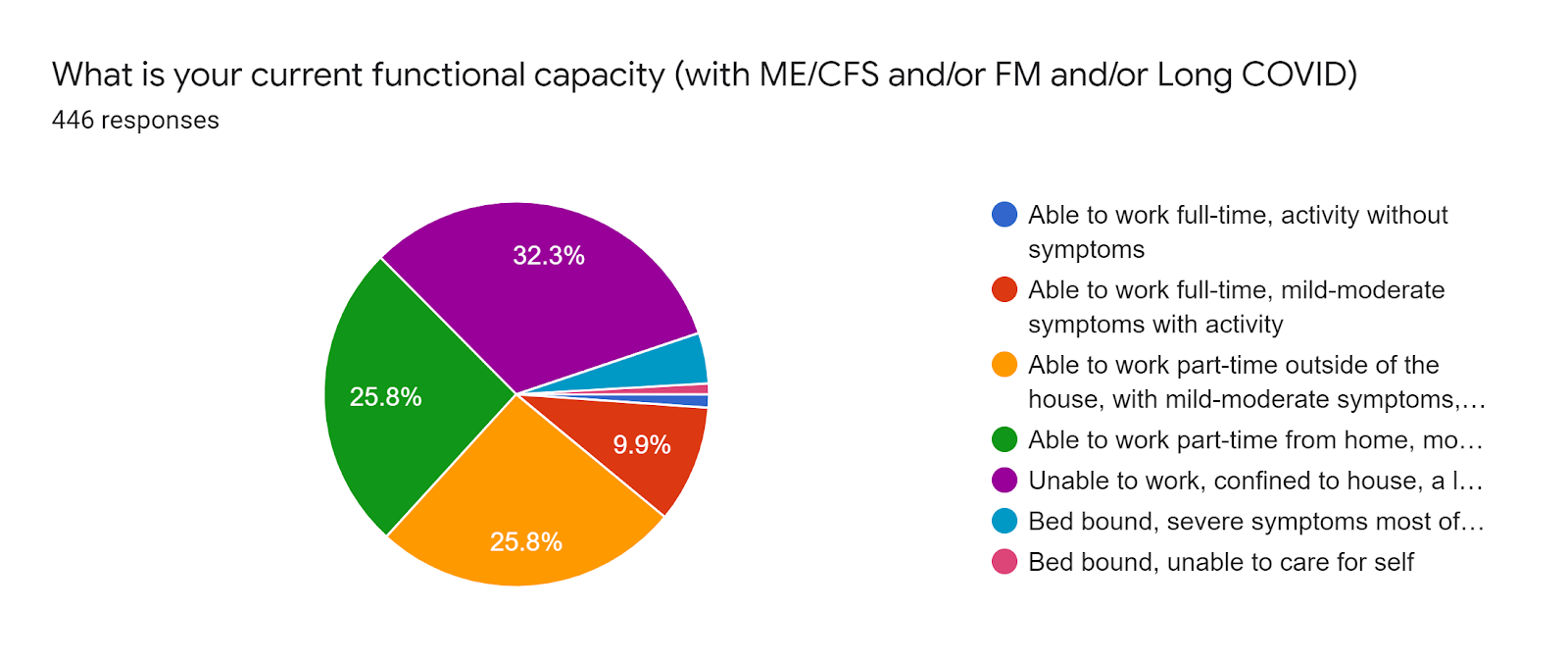
Forms response chart. Question title: What is your current functional capacity (with ME/CFS and/or FM and/or Long COVID). Number of responses: 446 responses.

  • 32.3% (144 individuals) are unable to work, confined to their home with a lot of rest required.
  • 25.8% (115) are able to work part-time at home.
  • 25.5* (115) are able to work part-time outside of the house.
  • 9.9% (44) are able to work full-time with mild-moderate symptoms with activity.
    1.1% (5) are able to work full-time without symptoms.
    * These respondents were mostly COVID-19 infection or Long COVID respondents without ME/CFS. 
  • 4.3% (19) are bedbound most of the time.
  • 0.9% (4) are bedbound and unable to care for themselves.

Vaccination rates

The majority of respondents have had two doses of the Pfizer vaccination.

  • 64.5% (296) two doses.
  • 16.1& (74) single dose.
  • 19.2% (88) have not been vaccinated.

Of the 296 with two doses, the duration between doses was 6 weeks or more for 166 individuals and 3 weeks for 130.

Pattern for capacity and reaction

These findings suggest that the more disabling the ME/CFS symptoms, the more prone to a relapse after vaccination but that relapse can occur at any functional capacity state for pwME. This was analysed when there were 241 responses.

Temporarily worsenedImprovedNo changeWorsened into relapseWorsened beyond illnessNot vaccinatedNo answer
Part-time work home228791142
Part-time outside house22317140122
Full-time work mild-mod with activity
ME
FM
Long COVID/COVID


3
2
0


0
0
2


4
1
3


3
1
0


0
0
0


2
0
1


2
0
5
Unable to work, confined to house23
6
3 temp
1518787
Bedbound mostly2003011
Bedbound unable to care for self0001011
Overall ME7220434883020

First dose vaccination reaction and duration

There were 39 individuals who did not experience any symptoms. For those who did experience reactions to the first dose of the vaccine, these were consistent with the expected normal immune response, e.g.: 

  • sore at injection site (300)
  • tired/fatigued (219)
  • Headache (142)
  • nausea/gastrointestinal issues (62)
  • fever/chills (56)
  • Swollen lymph nodes (46)
  • Sleep issues/insomnia (44)

5 people experienced heart palpitations and/or anxiety 3 people experienced skin sensitivity and/or allergy flares, with 2 people experiencing brain fog/cognitive issues.

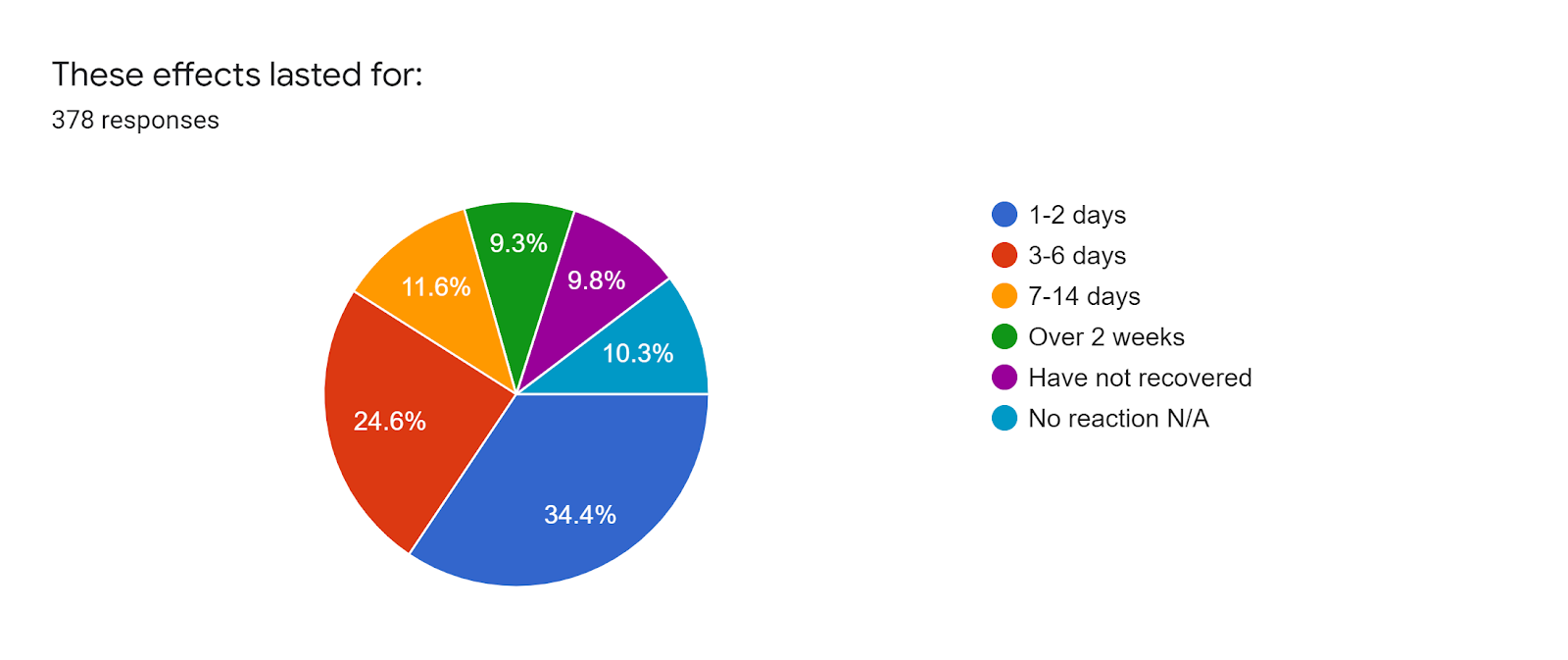
Forms response chart. Question title: These effects lasted for:. Number of responses: 378 responses.

  • For most people (130) these symptoms lasted 1-2 days.
  • For 93 individuals it lasted 3-6 days.
  • 44 experienced symptoms for 7-14 days.
  • 35 for over 2 weeks.
  • 37 have not recovered.

Second dose reaction and duration

As has been reported by the general public, the findings from this survey suggest that pwME also experienced more adverse reactions to the second dose of the Pfizer vaccine. However there were 54 individuals who did not experience any symptoms.

  • e.g. sore at injection site (213)
  • tired/fatigued (209)
  • Headache (139)
  • fever/chills (72)
  • Swollen lymph nodes (48)
  • Muscle aches/joint pain (147)

2 experienced skin sensitivity, 2 experienced fibromyalgia flare-ups, 2 experienced palpitations and/or anxiety symptoms, 2 experienced brain fog/cognitive issues.

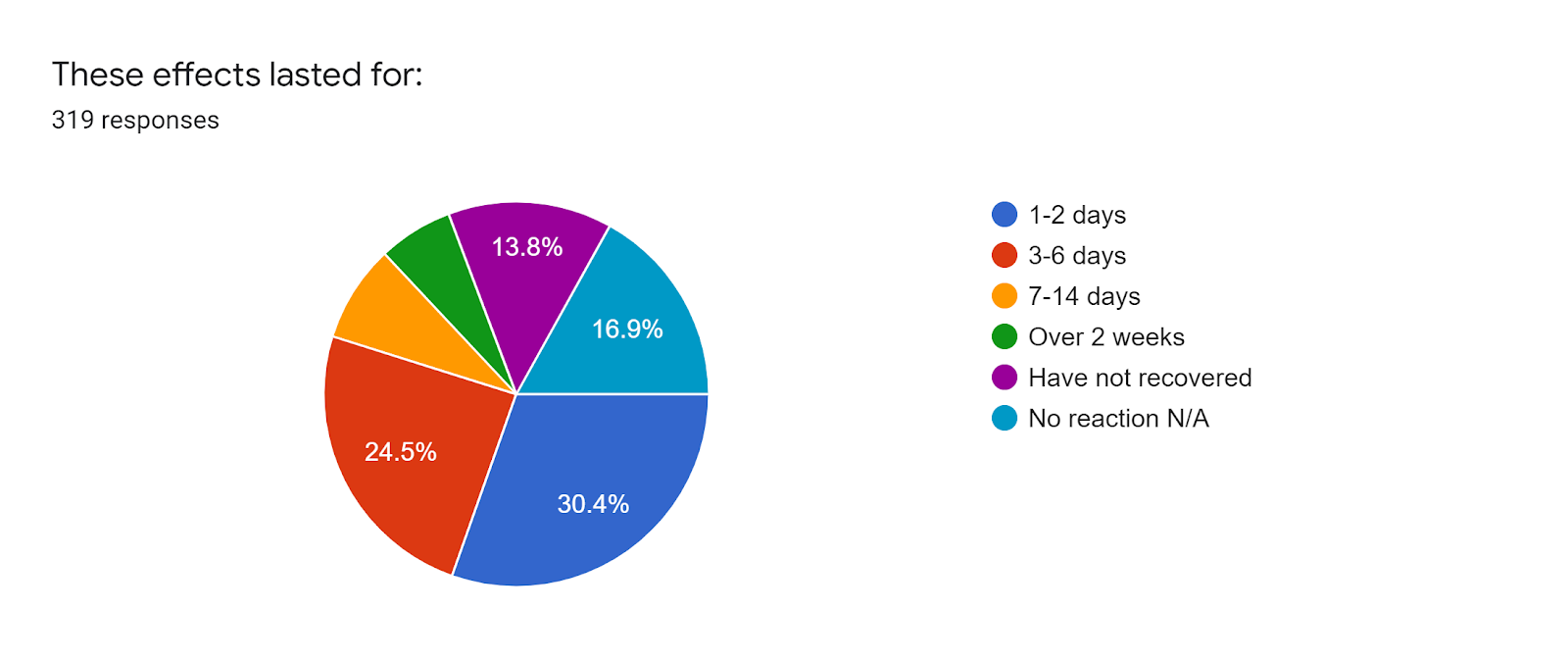
Forms response chart. Question title: These effects lasted for:. Number of responses: 319 responses.

  • For 97 individuals these symptoms lasted 1-2 days.
  • For 78 individuals it lasted 3-6 days.
  • 26 experienced symptoms for 7-14 days.
  • 20 for over 2 weeks.
  • 44 have not recovered.

Vaccine effect on state of illness/wellness for 359 respondents

  • 137 (38.1%) experienced no change/stay the same
  • 118 (32.9%) temporarily worsened but have returned to baseline
  • 71 (19.8%) worsened and not returned to baseline – relapsed
  • 22 (6.1%) improved
  • 11 (3.1%) worsened beyond anything experienced in illness to date – severe relapse

289 respondents did not have any new symptoms that they could attribute to the vaccine.

52 stated that they had new symptoms that they could attribute to the vaccine. These symptoms tended to be over-activation of the immune response, e.g. sore throat, swollen neck glands, allergy reactions. Of these 52 – 4 individuals have gastrointestinal issues, 2 experienced more fatigue whilst 1 indicated improved energy.

Clinical care

From 383 responses 314 (82%) were not offered clinical care during vaccination, 15 (3.9%) were offered clinical care, 19 (5%) were unsure. 25 people asked for specific clinical care during the vaccination process. Of those offered clinical care the options were 30 minute observation rather than the normal 15, separate areas with direct nurse observation. Others were advised by their GPs to rest and take antihistamines pre- and post-vaccination.

Caregiving requirements

From 353 respondents 50 require ongoing caregiving for their ME/CFS and/or FM and 70 required care after vaccination. 244 people do not require caregiving before and 230 after.

Fractionated dosing interest

If fractionated / lower dosing had been an option, of 115 responses 48 stated they would have considered it, 23 said they would not consider it and 44 were unsure.

Of 88 responses for those reluctant to have the vaccine, 57 would consider lower dosing options, 10 would not, and 21 were unsure.

Of 124 responses to indicate interest in participation in a potential trial into fractionated dosing, 61 responded that they are interested, 31 may be interested, and 32 are not.

Antihistamine usage

Of 115 responses 45 did not take any pre- or post-vaccination, 70 did.

Reasons for not being vaccinated

Of 1Anxiety/worry/fear about potential adverse reactions, previous adverse reactions to other vaccines, concern about the safety of the vaccine, high ME/CFS symptomatology, chemical sensitivities/MCS/MCAS, not currently well enough to risk adverse reactions.

COVID-19 / Long COVID

19 respondents have been diagnosed with SARS-CoV-2 (COVID-19) infection.

169 respondents have had COVID-19 tests.

5 people have been diagnosed by a medical professional with Long COVID.

32 people suspected they have Long COVID after a viral infection due to ongoing or lingering classic COVID-19 symptoms and having been connected to a location of interest, an overseas hot zone of infection, or have remained unwell after experiencing a viral infection that has not been confirmed as COVID but has the same symptoms.

Symptoms by response from 57 individuals:

  • Fatigue 41 (71.9%)
  • Brain fog/cognitive issues 39 (68.4%)
  • Shortness of breath 31 (54.4%)
  • Flu-like (fever chills, joint/muscle pain, headaches) 25 (43.9%)
  • Gastrointestinal 24 (42.1%)
  • Depression 10 (17.5%)
  • Organ damage 9 (15.8%)

Duration of illness with Long COVID or suspected Long COVID

From 57 responses

  • 14 individuals have been unwell for 18-22 months+
  • 6 individuals have been unwell for  6-10 months
  • 37 for less than 6 months
  • 1 for many years, a pre-COVID infection


Demographic information

From 447 responses, respondents identify as:

  • Female – 391 (87.5%)
  • Male – 47 (10.5%)
  • Non-binary – 7 (1.6%)
  • Prefer not to say – 2 (0.4%)

Age range from 453 responses:

  • Under 18 = 10 (2.2%)
  • 18-24 = 18 (4%)
  • 25-39 = 100 (22.1%)
  • 40-49 = 109 (24.1%)
  • 50-59 = 108 (23.8%)
  • 60-69 = 82 (18.1%)
  • 70-79 = 22 (4.9%)
  • 80+ = 4 (0.9%)

From 447 responses, respondents live in the following regions: 

  • Northland = 36 (8.1%)
  • Auckland = 143 (32.1%)
  • Bay of Plenty = 32 (7.2%)
  • Waikato = 21 (4.7%)
  • Gisborne = 3 (0.7%)
  • Hawkes Bay = 14 (3.1%)
  • Taranaki = 6 (1.1%)
  • Whanganui/Manawatu = 17 (3.8%)
  • Wairarapa = 1 (0.2%)
  • Wellington = 53 (11.9%)
  • Nelson/Tasman = 36 (8.1%)
  • Marlborough = 3 (0.7%)
  • West Coast = 2 (0.4%)
  • Canterbury = 47 (10.5%)
  • Otago = 40 (9%)
  • Southland = 9 (2%)
  • Overseas = 8 (1.8%)
  • Nomadic = 2 (0.4%)
Malcare WordPress Security